귀농 vs 귀촌: Farming Move or Rural Move in Korea (2026)
By the RuralRoof Editorial Team · Last updated 2026-11-07 · 6 official sources
귀농 and 귀촌 both mean leaving the city for the countryside, and the difference between them is set in law. 귀농 means moving to become a farmer. 귀촌 means moving without becoming one. The label decides which support you can apply for.
This guide reads the definitions in the Return to Farming and Rural Life Act and its Enforcement Decree. It explains the 1-year address rule, the legal test for a farmer, what counts as a rural area, and where a weekend-house buyer fits. It ends with the 2024 official numbers.
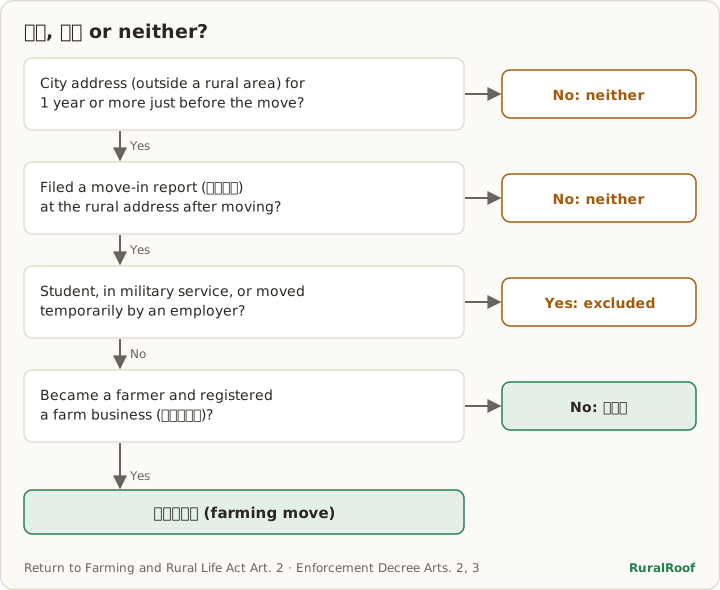
- A 귀농어업인 moved from a city to a rural area to farm, after 1 year or more of city address registration, and registered a farm business [1] [2].
- A 귀촌인 made the same move with the same 1-year rule but is not a farmer. Students, soldiers and staff moved by their employer are excluded [1] [2].
- A farmer (농업인) farms 1,000 m² or more, sells ₩1.2 million or more of farm produce a year, or works 90 days or more a year in farming, among other tests [4].
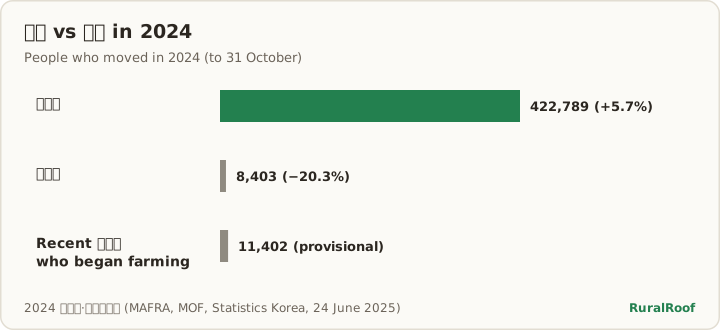
- In 2024, 422,789 people moved as 귀촌인 and 8,403 as 귀농인, according to the joint government statistics [6].
What is the difference between 귀농 and 귀촌?
The difference is farming. A 귀농어업인 moves to a rural area to become a farmer or fisher. A 귀촌인 moves to a rural area of their own will and is neither [1].
Both terms come from Article 2 of the Return to Farming and Rural Life Act (귀농어ㆍ귀촌 활성화 및 지원에 관한 법률). The Act covers fishing too, so the legal word is 귀농어업인, not just 귀농인 [1]. This guide focuses on farming.
| Point | 귀농어업인 (farming move) | 귀촌인 (rural move) |
|---|---|---|
| Before the move | Not a farmer or fisher; city address for 1+ year just before | Not a farmer or fisher; city address for 1+ year just before |
| Purpose | To become a farmer or fisher | Voluntary move, no farming required |
| After the move | 전입신고 (address report) in the rural area | 전입신고 in the rural area |
| Extra condition | Registered farm business (농업경영체), or a fisher | None |
| Excluded | - | Students, people in military service, temporary job transfers, 귀농어업인 |
The two groups share most rules. Both need the same 1-year city address history and the same address report after the move. The farm business registration is what separates them [2].
Who is a 귀농어업인 under Korean law?
Someone who was not a farmer, lived in a city, and moved to a rural area to farm. The Decree adds two conditions: the 1-year address rule and farm business registration [1] [2].
The Act defines a 귀농어업인 as a non-farmer living outside a rural area who moves there to become a farmer or fisher and meets the Decree's standard (Art. 2(3)) [1].
- Address: registered under the Resident Registration Act outside a rural area for 1 year or more just before the move [2].
- Report: after the move, filed a 전입신고 (move-in report) at the new rural address [2].
- Status: registered as a farm business (농업경영체) under the farm business entities Act, or is a fisher (Decree Art. 2(2)) [2] [5].
Farm business registration is a separate process. According to Article 4 of that Act, a farm business that wants farm-related loans or subsidies must register its business information. This covers land, facilities, crops and livestock [5].
Who is a 귀촌인, and who is excluded?
A 귀촌인 is a non-farmer who moved to a rural area voluntarily, after 1 year or more of city address registration, and then filed a move-in report there [1] [2].
“A person who had resident registration outside a rural area for 1 year or more just before moving to a rural area, and who filed a move-in report after moving to the rural area.”
Four groups are excluded even if they meet that test (Decree Art. 3) [2]:
- Students at schools under the Elementary and Secondary Education Act or the Higher Education Act.
- People doing military service under the Military Service Act.
- People who moved temporarily, for example because their workplace changed.
- 귀농어업인, who are counted in their own group instead.
The word 자발적 (voluntary) in the Act matters too [1]. The law aims at people who chose rural life, not people sent there for a period.
What counts as a farmer (농업인) in Korea?
Anyone who meets one of five tests in the Framework Act's Enforcement Decree. The tests cover farmed area, farm sales, days worked, or a year's employment at a farm company [3] [4].
| Test | Threshold |
|---|---|
| Farmland | Runs or cultivates 1,000 m² or more of farmland |
| Sales | Sells ₩1.2 million or more of farm produce a year |
| Days | Works in farming 90 days or more a year |
| Farming cooperative (영농조합법인) | Employed for 1 year or more in its shipping, distribution, processing or export work |
| Farm company (농업회사법인) | Employed for 1 year or more in its distribution, processing or sales work |
One test has a catch. Farmland attached to a rural house that a non-farmer bought or rented under Article 98 of the 농어촌정비법 does not count towards the 1,000 m² (Decree Art. 3(1)1) [4].
Farming here is broad. The Decree lists crop growing, mushrooms, sericulture, seedlings, livestock and forestry (Art. 2) [4]. The ministry sets how farmer status is checked (Art. 3(3)) [4].
What counts as a rural area for 귀농 and 귀촌?
A 읍 or 면 (town or township) area, plus other areas the agriculture minister designates by notice. Fishing villages, defined in a separate fisheries law, are added for the Act [1] [3].
The Act points to Article 3(5) of the Framework Act for the meaning of 농촌 [1]. That article lists 읍·면 areas first, then other areas chosen for their farming, farm industries, farm population and living conditions [3].
The official statistics use a simpler line. They count people who lived 1 year or more in a 동 (urban neighbourhood) area and then moved to a 읍 or 면 area during the year to 31 October [6].
Is a weekend-house buyer 귀농 or 귀촌?
Usually neither. Both statuses require a move-in report at the rural address. A buyer who keeps their city address and visits at weekends has not made that report [2].
A buyer who moves their registered address to the countryside, keeps a city job and does not farm fits the 귀촌인 test. This assumes 1 year or more of city registration first, and no exclusion [2].
However, a move made only because an employer changed your workplace is excluded (Decree Art. 3) [2]. A buyer who starts farming and registers a farm business becomes a 귀농어업인 instead [2] [5].
| Situation | Likely status |
|---|---|
| Weekend house, city address kept | Neither |
| Moved address, works remotely or locally, no farming | 귀촌인 |
| Moved address for a temporary job transfer | Excluded |
| Moved address, farms and registered a 농업경영체 | 귀농어업인 |
| Already lived in a rural area for years | Neither; may still be covered by Art. 7 (see below) |
Buying a rural house is a separate legal process from either status. The checks before you buy are in the rural house checklist.
What support does each status open?
Both groups can get housing and job support. Start-up money, farmland purchase support and early-years disaster help are written for 귀농어업인 only [1] [2].
The Act defines support money (지원금) as grants, loans, interest subsidies and tax benefits in any form (Art. 2(5)) [1]. Most articles say government "may" support, so the money depends on each year's programme [1].
- Both groups: help to buy, build, repair or rent a house (Art. 15(2)), job matching (Art. 15(1)1) and extra support for people under 40 (Art. 16(2)) [1].
- 귀농어업인 only: start-up funds, technology and business consulting (Art. 15(1)2) [1].
- 귀농어업인 only: costs of buying or renting farmland, barns and similar (Art. 17) [1].
- 귀농어업인 only: support within 3 years of the move if a natural disaster makes farming hard (Art. 8; Decree Art. 6) [1] [2].
Article 7 widens the circle. Programmes may include rural residents of 1 year or more who are not yet farmers but want to be. They may also include would-be movers who completed 8 hours or more of approved training (Decree Art. 5-2) [1] [2].
What the 2026 national loan actually pays, and who it excludes, is in the return-to-farm support guide.
How many people choose 귀농 or 귀촌?
귀촌 is far larger. In 2024, 422,789 people moved as 귀촌인 and 8,403 as 귀농인. 귀촌 rose 5.7% on the year, while 귀농 fell 20.3% [6].
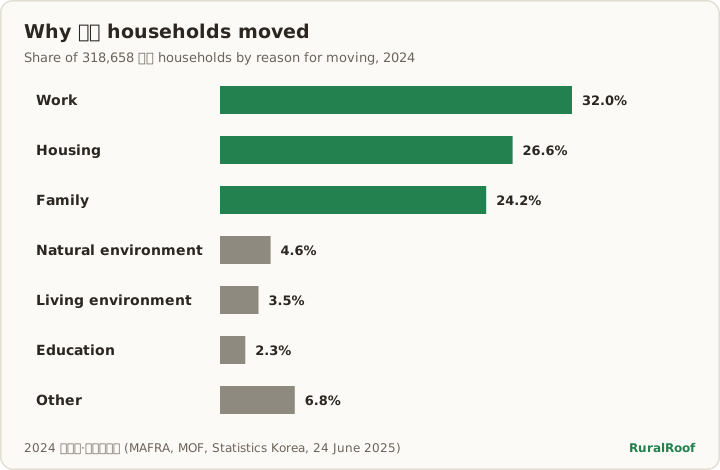
Jobs are the main reason for 귀촌. Among 귀촌 households, 32.0% gave work as the reason, 26.6% housing and 24.2% family. Only 4.6% named the natural environment [6].
The status can change. In 2024, 11,402 people who had moved as 귀촌인 in the previous 5 years started farming. Going the other way, 190,525 recent 귀촌인 and 2,202 recent 귀농인 moved to a 동 area in 2024. Both counts are provisional [6].
These numbers come from administrative records, such as the farm business register and farmland register, not a survey. The release states they may differ from the people who actually live there [6].
To see what rural houses cost before you choose, browse rural listings.
Frequently Asked Questions
What is the difference between 귀농 and 귀촌?
귀농 is moving to a rural area to become a farmer, with a registered farm business. 귀촌 is moving there without becoming a farmer. Both require 1 year of city address registration first [1] [2].
What does 귀농 mean (귀농 뜻)?
Literally a return to farming. In law, a 귀농어업인 is a former non-farmer who lived in a city for 1 year or more, moved to a rural area and registered as a farm business (Decree Art. 2) [2].
What does 귀촌 mean (귀촌 뜻)?
A return to the countryside. A 귀촌인 is a non-farmer who moved to a rural area voluntarily after 1 year or more of city registration and filed a move-in report there (Decree Art. 3) [2].
Does a city worker who moves to the countryside count as 귀촌?
Yes, if they had a city address for 1 year or more and moved their registration. A move made only because the employer changed the workplace is excluded (Decree Art. 3) [2].
How much land do I need to be a farmer in Korea?
1,000 m² is one of five tests. Others are ₩1.2 million of annual farm sales, 90 days of farm work a year, or a year's employment at a farm company (Framework Act Decree Art. 3) [4].
Can a 귀촌인 become a 귀농어업인 later?
The Decree does not bar it, as long as the person becomes a farmer and registers a farm business [2]. In 2024, 11,402 recent 귀촌인 started farming [6].
Is a 읍 a rural area?
Yes. 읍 and 면 areas are rural areas under Framework Act Art. 3(5), and the minister may designate others [3].
Related articles
- Rural House Checklist for Korea: 8 Records to Check (2026)
- Landlocked Land (맹지) in Korea: Road Access Rules (2026)
- Korea's Rural Empty House Bank: How It Works (2026)
- Rural Second Home Tax in Korea: Keep One-Home Relief (2026)
- Nongmak vs Rural Stay Shelter in Korea: 2026 Farmland Rules
- Unregistered Buildings (미등기 건물) in Korea: Buyer Risks (2026)
- How to Read a Korean Property Register: 3 Records (2026)
- Korea's Empty House Law: Rural vs Urban Rules (2026)
- Korea Farmland Register (농지대장): Buyer's Guide 2026
- Leasing Farmland in Korea: 농지은행 and the Law (2026)
- Farmland Capital Gains Tax in Korea: 8-Year Relief (2026)
- How Much Is a House in Korea? 2026 Seoul vs Rural Prices
- Farmland Acquisition Certificate (농취증) in Korea: 2026 Guide
- Build a House on Farmland in Korea: 2026 Permit Guide
- What Is a Farmhouse in Korea? 농가주택 Legal Meaning 2026
- Cheap Rural Houses in Korea: Real Prices and Costs (2026)
- Rural House Renovation Cost in Korea: Permits & Aid (2026)
- Free Empty House Rent in Rural Korea: What Exists (2026)
- Return-to-Farm Support in Korea: 2026 Loans and Grants
- Return-to-Farm Reality in Korea: 2026 Survey Numbers
- Farmland Disposal Order in Korea (농지 처분명령): 2026 Guide
- Rural House Acquisition Tax in Korea: 2026 Rates Guide
- Buying a House in South Korea as a Foreigner: 2026 Rules
- Alien Registration in Korea After Buying a House (2026)
- Cost of Living in South Korea 2026: Rural vs National
- Hanok Korean House: Buying and Restoring One (2026)
- Can Foreigners Buy Property in Japan? 2026 Akiya Bank Rules
General information, checked against the official sources below on the date shown. No sponsored content: no office, organization, agent or seller named here paid for or reviewed this page. Rules change, so confirm with the office named or a specialist (a licensed agent or a lawyer) before you sign.
Sources
- [1]귀농어ㆍ귀촌 활성화 및 지원에 관한 법률 (Return to Farming and Rural Life Act), Arts. 2, 7, 8, 10, 15, 16, 17 (in force 2026-06-02) · Korea Ministry of Government Legislation (law.go.kr) · accessed 2026-11-07
- [2]귀농어ㆍ귀촌 활성화 및 지원에 관한 법률 시행령 (Enforcement Decree), Arts. 2, 3, 5-2, 6 (in force 2023-09-29) · Korea Ministry of Government Legislation (law.go.kr) · accessed 2026-11-07
- [3]농업ㆍ농촌 및 식품산업 기본법 (Framework Act on Agriculture, Rural Community and Food Industry), Art. 3 (in force 2026-07-01) · Korea Ministry of Government Legislation (law.go.kr) · accessed 2026-11-07
- [4]농업ㆍ농촌 및 식품산업 기본법 시행령 (Enforcement Decree), Arts. 2, 3 (in force 2026-07-01) · Korea Ministry of Government Legislation (law.go.kr) · accessed 2026-11-07
- [5]농어업경영체 육성 및 지원에 관한 법률 (Act on Fostering Agricultural and Fishery Business Entities), Arts. 2, 4 (in force 2026-08-28) · Korea Ministry of Government Legislation (law.go.kr) · accessed 2026-11-07
- [6]2024년 귀농어·귀촌인통계 (2024 statistics on people returning to farming, fishing and rural areas), joint press release, 24 June 2025 · Ministry of Agriculture, Food and Rural Affairs (MAFRA), Ministry of Oceans and Fisheries and Statistics Korea · accessed 2026-11-07