Hanok Korean House: Buying and Restoring One (2026)
By the RuralRoof Editorial Team · Last updated 2026-10-26 · 7 official sources
A hanok Korean house is defined in law, and that definition decides which rules apply when you buy and restore one. The Hanok Act relaxes several Building Act limits and lets counties pay restoration subsidies.
This guide reads the act, its decree, the heritage law and two county ordinances. It covers what counts as a hanok, which repairs need a report, what counties pay, and when a heritage review applies. It leaves hanok tourism and hanok stays aside.
- A hanok is a building whose main structure is a timber frame of columns, beams and a Korean-style roof frame, reflecting the traditional style (Hanok Act Art. 2) [1].
- Repairs within 60 cm of a hanok column base are not major repair, whatever the number of columns, and rafters do not count as roof trusses [2] [4].
- Counties set hanok subsidies by ordinance: Goheung pays up to ₩20 million for a new build and ₩5 million for major repair, after completion [2] [6].
- Building within a heritage site's preservation area, usually within 500 m, needs a heritage impact review before the permit (Cultural Heritage Act Art. 13) [5].
What is a hanok under Korean law?
A hanok is a building with a timber frame of columns, beams and a Korean-style roof frame, in the traditional style. Its annex buildings count too (Hanok Act Art. 2(2)) [1].
“"Hanok" means a building, and its annex buildings, whose main structure is a timber structure of columns, beams and a Korean-style roof frame and which reflects Korea's traditional style.”
The act also defines a hanok building style (한옥건축양식). It covers buildings with a hanok's form and structure, including ones built with modern materials and techniques (Art. 2(3)) [1].
However, a hanok designated or registered as cultural heritage is not an architectural asset under this act. It falls under the heritage laws instead (Art. 2(1)) [1].
Which hanok repairs count as major repair?
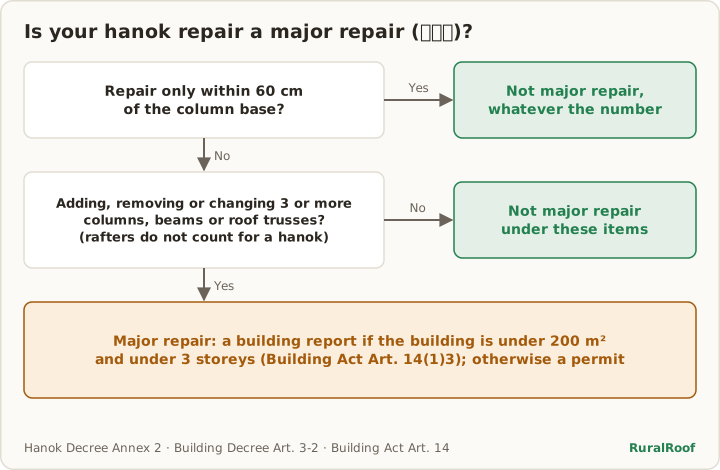
Changing three or more columns, beams or roof trusses is major repair (대수선). For a hanok, rafters are excluded from roof trusses (Building Decree Art. 3-2) [4].
The Hanok Decree adds a wider exception. Repairs within 60 cm of the base of a hanok column are not major repair, whatever the number of columns (Annex 2, item 1) [2].
For example, replacing the decayed feet of several columns is not major repair, as long as the work stays within 60 cm of the base [2].
Major repair on a building under 200 m² and under three storeys needs only a building report, not a permit (Building Act Art. 14(1)3) [3]. The county answers within 5 days, or 20 days where another review is needed (Art. 14(3)) [3].
Which building rules are relaxed for a hanok?
Seven areas qualify. The Hanok Act lets the decree set separate rules for major repair, structural checks, setbacks, sunlight height, floor area, energy design and the Civil Code boundary rule (Art. 26) [1]. Annex 2 sets six of them [2].
| Rule | What applies to a hanok |
|---|---|
| Major repair (Building Act Art. 2(1)9) | Repairs within 60 cm of a column base are not major repair |
| Open space on the site (Building Act Art. 58) | Outer wall at least 1 m from the building line and boundary; no limit for the eaves line |
| Sunlight height rule (Building Act Art. 61(1)) | Parts up to 9 m high set back at least 0.5 m from the neighbouring boundary |
| Building area (Building Act Art. 84) | A bay (반침) not projecting past the eaves line and no higher than the eaves edge is not counted |
| Floor area (Building Act Art. 84) | An attic between the column-top purlin and the ridge purlin, averaging 1.8 m high or less, is not counted |
| Energy design (Green Building Act Arts. 14, 15) | No energy-saving plan is submitted; the ministry's hanok standard applies if published |
| Building near a boundary (Civil Code Art. 242(1)) | Not applied; the 1 m outer-wall rule above applies |
Where it is unclear whether a building is a hanok, the permit authority may refer it to the building committee (Decree Art. 19(2)) [2].
What hanok subsidies do counties offer?
Counties may give technical help and subsidies for building hanok (Hanok Act Art. 24) [1]. Who qualifies, and how much, is set by each county's ordinance (Decree Art. 17) [2].
The decree lists three kinds of support. They are technical advice and supervision, project subsidies and loans within the ordinance's limits, and other items the ordinance sets (Decree Art. 17(2)) [2].
Two county ordinances show the range. Both pay only after the work is finished, and both can claw the money back [6] [7].
| Item | Goheung County (2026) | Gangjin County (2023) |
|---|---|---|
| Who can apply | Hanok in designated hanok pilot villages, liveable-region villages or jeonwon villages, approved by the building committee | Hanok in Jeonnam pilot villages, or ones the county links to tourism projects |
| Cap | New build or rebuild ₩20 million; major repair ₩5 million | Up to half of total cost, at most ₩20 million, by floor area |
| Start of work | Within 8 months of the notice | Within 1 month of the notice |
| Payment | After completion | After completion, earlier in unavoidable cases |
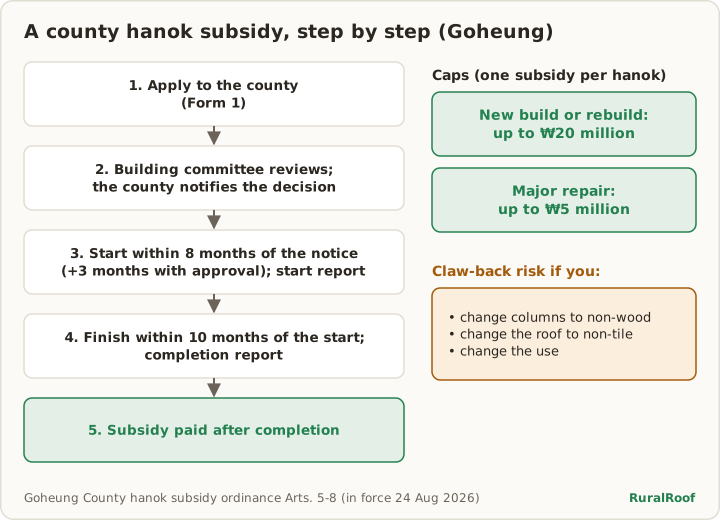
Goheung also limits each hanok to one subsidy. It can order restoration, then claw back the money, if an owner changes the columns from wood, the roof from tiles, or the use (Arts. 5, 8) [6].
How do you apply for a hanok subsidy?
Apply to the county with a hanok building plan and drawings. The county decides after a building committee review (Hanok Act Art. 25) [1]. Both ordinances put the decision before the start of work [6] [7].
- Application form and hanok building plan [2].
- Proof that you own or may use the site [2].
- Location map and photos of the current state [2].
- Site plan, floor plans, elevations and sections [2].
- Spending plan, if you ask for money [2].
- A statement of why support is needed [2].
Gangjin forbids starting work before the subsidy notice and asks for a start report first (Art. 13) [7]. Goheung asks for a start report and a completion report, and cancels support if work is not finished within 10 months of starting (Arts. 6, 8) [6].
Do you need permission near a cultural heritage site?
Often, yes. Each province sets a historic-cultural environment preservation area around designated heritage, normally within 500 m of its outer boundary (Cultural Heritage Act Art. 13(1), (3)) [5].
Before permitting construction in that area, the permit office must run a simplified heritage impact review. Where specific conduct standards have been published, work within them skips the review (Art. 13(2), (7)) [5].
Work that alters a nationally designated heritage site, its protected object or its protected area needs a permit from the Korea Heritage Service (Art. 35(1)) [5]. The answer is due within 30 days, not counting committee review time (Art. 35(4)) [5].
What drives hanok restoration cost?
RuralRoof found no official price per square metre for hanok restoration. The real cost comes from quotes; the official rules decide which works trigger extra steps [2] [6].
- Structure: three or more columns, beams or roof trusses means major repair and paperwork [4].
- Materials: subsidised hanok must keep wooden columns and a tiled roof in Goheung [6].
- Drawings: a subsidy application needs plans, elevations and sections [2].
- Time: committee reviews and heritage reviews add steps before work starts [1] [5].
A province can also list a valued building as a registered architectural asset (우수건축자산), at the owner's request. Buildings over 50 years old need the heritage service's opinion first (Hanok Act Art. 10) [1].
Registration can bring tax relief under the tax laws and cost support set by provincial ordinance (Art. 12) [1]. In return, changing its exterior or demolishing it needs a report 30 days ahead, or a permit if you received support (Art. 13) [1].
Skipping that report can bring a fine of up to ₩5 million (Art. 42) [1].
How do you check a countryside hanok before you buy?
Check the law first, then the timber. The process takes one visit to the county office.
- Read the building register: structure, floor area and storeys [3].
- Ask whether the county treats it as a hanok for the special rules [2].
- Ask whether it is registered heritage or a registered architectural asset [1].
- Ask whether the plot lies in a heritage preservation area [5].
- Read the county hanok ordinance: who qualifies, caps and start deadlines [6] [7].
A hanok purchase still needs every check in the rural house checklist. For the general works and loans, read the rural house renovation cost guide. To compare prices, browse rural listings.
Frequently Asked Questions
What is a hanok?
Under the Hanok Act, a building whose main structure is a timber frame of columns, beams and a Korean-style roof frame, in the traditional style, with its annex buildings [1].
Is replacing rotten column bases major repair?
Not when the repair stays within 60 cm of the column base. The Hanok Decree says that is not major repair, whatever the number of columns [2].
Do rafters count when you repair a hanok roof?
No. For a hanok, rafters are excluded from roof trusses when counting major repair, so only three or more trusses count (Building Decree Art. 3-2) [4].
How much is a hanok subsidy in Korea?
It depends on the county ordinance. Goheung pays up to ₩20 million for a new build and ₩5 million for major repair; Gangjin pays up to half the cost, at most ₩20 million [6] [7].
Can I get a hanok subsidy after the work is done?
Both ordinances set the order: apply, receive the decision, then start work. Gangjin forbids starting before the notice. Money is paid after completion [6] [7].
Do I need heritage permission to restore a hanok?
Only in some cases: near designated heritage, within the preservation area (usually up to 500 m), or when altering designated heritage itself (Cultural Heritage Act Arts. 13, 35) [5].
Does a hanok need an energy-saving plan?
No. The Hanok Decree says a hanok builder does not submit the Green Building Act energy-saving plan; the ministry's hanok standard applies if published [2].
Related articles
- Rural House Checklist for Korea: 8 Records to Check (2026)
- Landlocked Land (맹지) in Korea: Road Access Rules (2026)
- Korea's Rural Empty House Bank: How It Works (2026)
- Rural Second Home Tax in Korea: Keep One-Home Relief (2026)
- Nongmak vs Rural Stay Shelter in Korea: 2026 Farmland Rules
- Unregistered Buildings (미등기 건물) in Korea: Buyer Risks (2026)
- Farmland Acquisition Certificate (농취증) in Korea: 2026 Guide
- Build a House on Farmland in Korea: 2026 Permit Guide
- What Is a Farmhouse in Korea? 농가주택 Legal Meaning 2026
- Cheap Rural Houses in Korea: Real Prices and Costs (2026)
- Rural House Renovation Cost in Korea: Permits & Aid (2026)
- Free Empty House Rent in Rural Korea: What Exists (2026)
- Return-to-Farm Support in Korea: 2026 Loans and Grants
- Return-to-Farm Reality in Korea: 2026 Survey Numbers
- Farmland Disposal Order in Korea (농지 처분명령): 2026 Guide
- Rural House Acquisition Tax in Korea: 2026 Rates Guide
- Buying a House in South Korea as a Foreigner: 2026 Rules
- Alien Registration in Korea After Buying a House (2026)
- Cost of Living in South Korea 2026: Rural vs National
- Can Foreigners Buy Property in Japan? 2026 Akiya Bank Rules
General information, checked against the official sources below on the date shown. No sponsored content: no office, organization, agent or seller named here paid for or reviewed this page. Rules change, so confirm with the office named or a specialist (a licensed agent or a lawyer) before you sign.
Sources
- [1]한옥 등 건축자산의 진흥에 관한 법률 (Act on Value Enhancement of Architectural Assets including Hanok), Arts. 2, 10, 12, 13, 24, 25, 26, 42 (in force 2024-09-15) · Korea Ministry of Government Legislation (law.go.kr) · accessed 2026-10-26
- [2]한옥 등 건축자산의 진흥에 관한 법률 시행령 (Enforcement Decree of the Hanok Act), Arts. 17, 18, 19 and Annex 2 (in force 2026-03-26) · Korea Ministry of Government Legislation (law.go.kr) · accessed 2026-10-26
- [3]건축법 (Building Act), Art. 14 (in force 2026-02-27) · Korea Ministry of Government Legislation (law.go.kr) · accessed 2026-10-26
- [4]건축법 시행령 (Enforcement Decree of the Building Act), Art. 3-2 (in force 2026-10-06) · Korea Ministry of Government Legislation (law.go.kr) · accessed 2026-10-26
- [5]문화유산의 보존 및 활용에 관한 법률 (Cultural Heritage Act), Arts. 13, 35 (in force 2026-06-24) · Korea Ministry of Government Legislation (law.go.kr) · accessed 2026-10-26
- [6]고흥군 한옥보조금 지원 조례 (Goheung County hanok subsidy ordinance), Arts. 3, 5-8 (in force 2026-08-24) · Korea Ministry of Government Legislation (law.go.kr) · accessed 2026-10-26
- [7]강진군 한옥 지원 조례 (Gangjin County hanok support ordinance), Arts. 2, 3, 12, 13, 17, 18 (in force 2023-11-06) · Korea Ministry of Government Legislation (law.go.kr) · accessed 2026-10-26