Rural House Acquisition Tax in Korea: 2026 Rates Guide
By the RuralRoof Editorial Team · Last updated 2026-10-25 · 6 official sources
Rural house acquisition tax (시골집 취득세) in Korea is usually small: 1% of the price for a house bought for ₩600 million or less. However, the rate changes with how many homes your household owns and how the building is recorded.
This guide reads the Local Tax Act and its decree as in force in October 2026. It shows the rates, three worked examples, the multi-home surcharge, the rural exceptions to it, and the filing deadline.
- A house recorded as a house and bought for ₩600 million or less pays 1% acquisition tax, plus 0.1% local education tax (Local Tax Act Arts. 11, 151) [1].
- A second home in an adjustment target area, or a third home elsewhere, pays 8%; more homes can mean 12% (Art. 13-2) [1].
- Outside the capital region, a house with a standard value (시가표준액) of ₩200 million or less is not surcharged (Decree Art. 28-2) [2].
- You must file and pay within 60 days of acquisition, to the local government where the property is (Arts. 8, 20) [1].
How much acquisition tax do you pay on a rural house in Korea?
Usually 1% of the purchase price. That rate covers a house recorded as a house and bought for ₩600 million or less (Local Tax Act Art. 11(1)8) [1].
The tax base is the actual price paid. According to Article 10-3, that means every cost the buyer paid to acquire the property [1].
| What you buy | Rate |
|---|---|
| House, price ₩600m or less | 1% |
| House, price over ₩600m up to ₩900m | (price × 2 ÷ ₩300m − 3) × 1%, between 1% and 3% |
| House, price over ₩900m | 3% |
| Farmland | 3% |
| Other real estate (not recorded as a house) | 4% |
Purchases of ₩500,000 or less pay no acquisition tax (Art. 17) [1]. Rural houses rarely sell above ₩600 million, so the 1% line is the one most buyers meet.
What do worked examples at ₩30m, ₩100m and ₩300m look like?
For a household with no other home, the total is 1.1% of the price. That is 1% acquisition tax plus 0.1% local education tax [1].
Local education tax on a house is the house rate times 50%, times 20% (Art. 151(1)1) [1]. At the 1% rate, that gives 0.1%.
| Price | Acquisition tax | Local education tax | Total |
|---|---|---|---|
| ₩30 million | 1% = ₩300,000 | 0.1% = ₩30,000 | ₩330,000 |
| ₩100 million | 1% = ₩1,000,000 | 0.1% = ₩100,000 | ₩1,100,000 |
| ₩300 million | 1% = ₩3,000,000 | 0.1% = ₩300,000 | ₩3,300,000 |
| ₩300 million, surcharged third home | 8% = ₩24,000,000 | 0.4% = ₩1,200,000 | ₩25,200,000 |
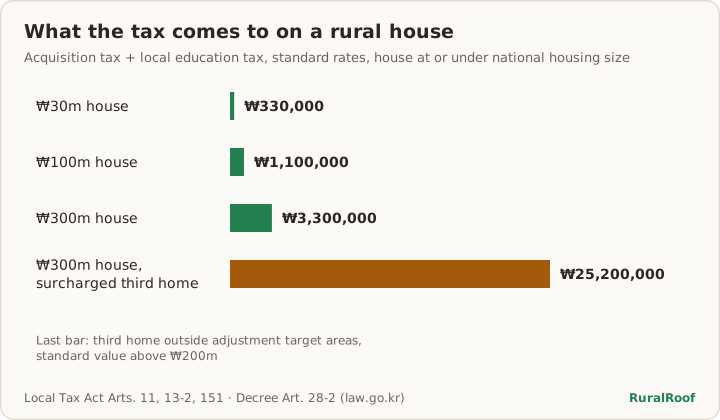
The last row assumes a third home outside adjustment target areas with a standard value above ₩200 million. The surcharge then multiplies the bill by more than seven.
A special tax for rural development (농어촌특별세) also applies to some purchases. A house at or under national housing size, with its land within a size limit, is exempt (Special Tax for Rural Development Act Art. 4(11)) [5].
When does a second or third home pay the surcharge?
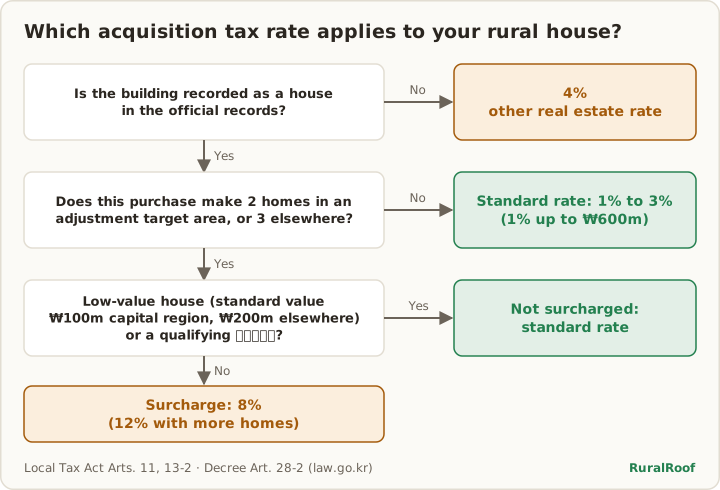
When the purchase takes the household to two homes in an adjustment target area, or to three homes elsewhere. The rate is then 8% (Art. 13-2(1)2) [1].
The surcharge rates add a multiple of the 2% "standard surcharge rate" to the 4% base (Arts. 6(19), 13-2) [1]. The count includes the home being bought (Decree Art. 28-4(1)) [2].
| Homes after purchase | In an adjustment target area | Elsewhere |
|---|---|---|
| 1 | Standard rate (1% to 3%) | Standard rate (1% to 3%) |
| 2 | 8% (temporary two-home cases excepted) | Standard rate |
| 3 | 12% | 8% |
| 4 or more | 12% | 12% |
For example, a Seoul flat owner buying one village house outside adjustment target areas has two homes. The village house pays the standard rate, not 8%.
Adjustment target areas are designated under the Housing Act and can change. Check the current designation for the address before you rely on the table [1] [6].
Which rural houses are exempt from the surcharge?
Low-value houses and qualifying rural houses (농어촌주택). The decree states that neither is treated as a surcharge target (Decree Art. 28-2) [2].
The value test uses the standard value (시가표준액), not the price. The cap is ₩100 million in the capital region and ₩200 million elsewhere (Art. 28-2(1)) [2].
“Where it is located outside the capital region: a house with a standard value of 200 million won or less.”
A qualifying rural house must be in a 읍 or 면, on a plot of up to 660㎡, with a floor area up to 150㎡. The building value must be ₩65 million or less (Art. 28-2(11)) [2].
Among other zones, the rural-house test excludes metropolitan city counties, the capital region (with listed exceptions), urban areas and land-transaction permit zones (Art. 28-2(11)) [2].
These houses also drop out of the count for your next purchase, while they still meet the value test (Decree Art. 28-4(6)1) [2]. Low-value houses in redevelopment zones do not qualify [2].
Why does the building register decide the rate?
The 1% to 3% housing rates apply only to a building recorded as a house in the building register or the land register (Art. 11(1)8) [1].
A residential building missing from those records falls back to the 4% rate for other real estate [1]. In practice, that is common with old village houses.
The Act makes one exception. A house that could lawfully be built without a permit before Building Act amendment No. 7696 is treated as recorded, even if it is missing from the building register (Art. 11(1)8) [1].
Check the records first. Our unregistered building guide explains how to read them.
Which reliefs can cut acquisition tax on a rural house?
Three reliefs in the Restriction of Special Local Taxation Act fit rural buyers. When more than one applies, only the larger reduction is given (Art. 180) [3].
| Relief | Who and what | Reduction | Until |
|---|---|---|---|
| First home (Art. 36-3) | Korean national, you and your spouse never owned a home, own residence, price up to ₩1.2bn | Tax up to ₩3m waived in a population-decline area (₩2m for most other houses); above that, the same amount deducted | 31 Dec 2028 |
| Population-decline area (Art. 75-5(4)) | No home or one home; decree caps and areas apply | 25% of the tax, up to ₩750,000; counties may add up to 25% more, ₩1.5m in total | 31 Dec 2028 |
| Rural house improvement (Art. 16) | Selected under a house improvement plan; up to 150㎡; you live there | Tax up to ₩2.8m waived; above that, ₩2.8m deducted | 31 Dec 2027 |
For the decline-area relief, the price cap is ₩1.2 billion in decline areas outside the capital region and ₩300 million elsewhere. One-home owners must buy outside their current 시·군·구 (Decree Art. 35-6(4)) [4].
For example, a Korean first-time buyer of a ₩100 million house in a population-decline area owes ₩1 million. That is under ₩3 million, so the acquisition tax is waived [3].
Each relief is clawed back if conditions break. Selling within 3 years ends the first-home and decline-area reliefs; renting it out within 3 years also ends the first-home relief (Arts. 36-3(4), 75-5(6)) [3].
When and where do you file acquisition tax?
Within 60 days of the acquisition date, to the local government where the property is located (Local Tax Act Arts. 8, 20(1)) [1].
Missing the deadline adds penalty tax under the Framework Act on Local Taxes (Art. 21(1)) [1]. Selling the property without filing adds 80% to the tax (Art. 21(2)) [1].
- Confirm the building is recorded as a house, and its floor area.
- Count every home your household owns, including the one you are buying.
- Ask the county for the standard value (시가표준액) of the house.
- Check whether the address is in an adjustment target area or a population-decline area.
- File and pay within 60 days, then claim any relief that applies.
Tax is one cost among several. Start with the rural house checklist, see the rural second home tax guide for capital gains, then use address search or browse rural listings.
Frequently Asked Questions
What is the acquisition tax rate on a rural house in Korea?
1% for a house recorded as a house and bought for ₩600 million or less, plus 0.1% local education tax [1].
Does a country house as a second home pay 8%?
Only if it is in an adjustment target area. A second home elsewhere pays the standard rate; a third home elsewhere pays 8% (Art. 13-2) [1].
Which houses are never surcharged?
Among others, a house with a standard value of ₩200 million or less outside the capital region (₩100 million inside it), and qualifying 읍·면 rural houses with a building value up to ₩65 million [2].
Do foreigners pay a different acquisition tax rate?
The Local Tax Act rates in Article 11 do not depend on nationality [1]. However, the first-home relief is limited to Korean nationals (Art. 36-3) [3].
How long do I have to pay acquisition tax?
60 days from the acquisition date, filed with the local government where the property is (Arts. 8, 20) [1].
Can I combine the first-home and decline-area reliefs?
No. When two reliefs apply to the same tax, only the one with the larger reduction is given (Art. 180) [3].
Related articles
- Rural House Checklist for Korea: 8 Records to Check (2026)
- Landlocked Land (맹지) in Korea: Road Access Rules (2026)
- Korea's Rural Empty House Bank: How It Works (2026)
- Rural Second Home Tax in Korea: Keep One-Home Relief (2026)
- Nongmak vs Rural Stay Shelter in Korea: 2026 Farmland Rules
- Unregistered Buildings (미등기 건물) in Korea: Buyer Risks (2026)
- Farmland Acquisition Certificate (농취증) in Korea: 2026 Guide
- Build a House on Farmland in Korea: 2026 Permit Guide
- What Is a Farmhouse in Korea? 농가주택 Legal Meaning 2026
- Cheap Rural Houses in Korea: Real Prices and Costs (2026)
- Rural House Renovation Cost in Korea: Permits & Aid (2026)
- Free Empty House Rent in Rural Korea: What Exists (2026)
- Return-to-Farm Support in Korea: 2026 Loans and Grants
- Return-to-Farm Reality in Korea: 2026 Survey Numbers
- Farmland Disposal Order in Korea (농지 처분명령): 2026 Guide
- Buying a House in South Korea as a Foreigner: 2026 Rules
- Alien Registration in Korea After Buying a House (2026)
- Can Foreigners Buy Property in Japan? 2026 Akiya Bank Rules
General information, checked against the official sources below on the date shown. No sponsored content: no office, organization, agent or seller named here paid for or reviewed this page. Rules change, so confirm with the office named or a specialist (a licensed agent or a lawyer) before you sign.
Sources
- [1]지방세법 (Local Tax Act), Arts. 6, 8, 10-3, 11, 13-2, 17, 20, 21, 151 (in force 2026-07-01) · Korea Ministry of Government Legislation (law.go.kr) · accessed 2026-10-25
- [2]지방세법 시행령 (Local Tax Act Enforcement Decree), Arts. 28-2, 28-4 (in force 2026-10-01) · Korea Ministry of Government Legislation (law.go.kr) · accessed 2026-10-25
- [3]지방세특례제한법 (Restriction of Special Local Taxation Act), Arts. 16, 36-3, 75-5, 180 (in force 2026-06-02) · Korea Ministry of Government Legislation (law.go.kr) · accessed 2026-10-25
- [4]지방세특례제한법 시행령 (Enforcement Decree), Art. 35-6 (in force 2026-09-18) · Korea Ministry of Government Legislation (law.go.kr) · accessed 2026-10-25
- [5]농어촌특별세법 (Special Tax for Rural Development Act), Arts. 4, 5, and Enforcement Decree Art. 4 · Korea Ministry of Government Legislation (law.go.kr) · accessed 2026-10-25
- [6]주택법 (Housing Act), Art. 2 (in force 2026-09-08) · Korea Ministry of Government Legislation (law.go.kr) · accessed 2026-10-25