Leasing Farmland in Korea: 농지은행 and the Law (2026)
By the RuralRoof Editorial Team · Last updated 2026-11-04 · 5 official sources
Leasing farmland in Korea is not a private matter between two people. The Farmland Act bans leasing farmland out, then lists the cases where it is allowed. A lease outside those cases can bring a fine of up to 20 million won.
This guide explains when a lease is legal, how the 농지은행 trust lease works, and what the contract must contain. It covers the minimum term, renewal and disputes, and what a buyer of rented farmland should check. Every rule comes from a statute on law.go.kr.
- Leasing out farmland is banned except in the cases listed in Farmland Act Art. 23(1), such as inherited land, temporary illness or an owner aged 60 or over [1].
- An individual who has owned farmland for 3 years or more can lease it legally by entrusting it to 농지은행, the Korea Rural Community Corporation (KRC), for at least 5 years [1] [5].
- A lease must last at least 3 years, or 5 for perennial crops and greenhouses, and is renewed on the same terms if the landlord gives no notice 3 months before the end [1] [2].
- A lease confirmed by the township office, with the land handed over, binds third parties from the next day. It must also be reported to the 농지대장 within 60 days [1].
Can you lease out farmland in Korea?
Only in listed cases. The Farmland Act starts from a ban: farmland may not be leased or lent free of charge, except in the cases in Art. 23(1) [1].
“Farmland may not be leased or lent for free use, except in any of the following cases.”
The ban follows from the Act's core rule. Farmland may be owned only by people who use it, or will use it, for their own farming (Art. 6(1)) [1]. A landlord who does not farm is the exception the law has to allow for.
Breaking the ban is a crime. Leasing or lending farmland in breach of Art. 23(1) carries a fine of up to 20 million won (Art. 61) [1]. The rest of this guide sets out the legal routes.
One group sits outside the rule. The 2007 restatement of the Act states that Arts. 6(1), 10, 11 and 23 do not apply to farmland a person already owned on 1 January 1996, when the Farmland Act took effect (Addendum Art. 4 of Act No. 8352) [1].
When is leasing farmland legal under the Farmland Act?
When the owner fits one of the cases listed in Art. 23(1). The common ones cover inherited land, temporary absence, older farmers, weekend farming and trust leasing through 농지은행 [1].
| Case | Condition | Rule |
|---|---|---|
| Inherited land | Land acquired by inheritance, including a bequest to an heir | Art. 23(1)1, Art. 6(2)4 |
| Former farmer | Kept after farming it for 8 years or more, then leaving farming | Art. 6(2)5; Decree Art. 4 |
| Temporary absence | Illness, call-up, study, election, injury needing 3+ months of care, 3+ months abroad, pregnancy or under 6 months after birth | Art. 23(1)3; Decree Art. 24(1) |
| Owner aged 60+ | Farmed the land personally for over 5 years; land in or next to the city or county where they live | Art. 23(1)4; Decree Art. 24(2) |
| Weekend farming | Owned 3+ years; leased to weekend or hobby farmers, or to a business that leases to them | Art. 23(1)5 |
| Trust leasing | Owned 3+ years; entrusted to KRC (농지은행) or another body set by decree | Art. 23(1)6 |
| Second crop | Own farmland, leased for a second crop (이모작) for up to 8 months | Art. 23(1)8 |
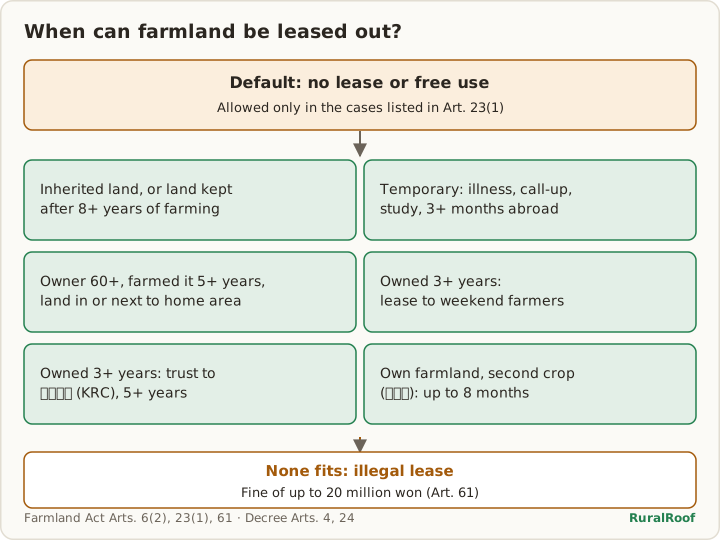
Other items cover land owned by the state, land under a farmland-use promotion plan, inherited land above the ownership cap, and set national projects (Art. 23(1)) [1]. In practice, check the exact item with the township office before you sign.
How does 농지은행 trust leasing work?
The owner entrusts the land to the Korea Rural Community Corporation, which leases it out for them. The KRC calls this business 농지은행 (farmland bank) [1] [4].
The law gives the KRC a farmland bank unit for this work. Its listed tasks include buying, selling and leasing farmland, and taking farmland in trust for lease (KRC Act Art. 5-2(1)) [4].
The KRC may take in trust the lease, free use or sale of farmland owned by the state, local governments, public bodies, companies or individuals (KRC Act Art. 24-4(1)) [4]. For an individual, the Farmland Act adds the 3-year ownership condition (Art. 23(1)6) [1].
- The trust covers one parcel of farmland or more (KRC Decree Art. 19-7(1)) [5].
- A lease or free-use trust runs for 5 years or more; a sale trust runs for up to 6 months (Art. 19-7(3)) [5].
- The KRC cannot take farmland in a residential, commercial or industrial zone, or land with a conversion permit or report (Art. 19-7(2)) [5].
- The commission follows the rate table in Annex 1 of the KRC Decree (Art. 19-8) [5].
Trust leasing also protects certain owners. Heirs and former farmers must sell within a year once the county finds the land unused for their own farming, unless they have a valid reason such as a KRC trust lease (Art. 10(1)4-2, 4-3) [1].
The Decree also counts any legal lease under Art. 23(1) as a valid reason not to sell (Decree Art. 9) [2]. So a lawful lease keeps the land safe from a sale order on that ground.
There is an exit route too. The KRC may buy farmland it has held in trust and leased for 5 years or more in a row, at a price set by a certified appraiser (KRC Decree Art. 19-2) [5].
Can you rent farmland from 농지은행?
Yes, if you farm. The KRC may rent land from farmers who are retiring or changing jobs, and lease it on to full-time farmers, trainee full-time farmers or farm corporations (KRC Act Art. 19) [4].
The KRC can also lease out farmland it owns. It may sell or lease that land to full-time farmers, farm corporations and others set by ministry ordinance (KRC Decree Art. 19-3(1)) [5].
For land it owns, the rent is agreed with the tenant, taking local farmland rents into account (Art. 19-3(3)) [5]. Selection rules and rent rates for the long-term lease programme are set by ministry ordinance (KRC Act Art. 19(5)) [4].
A third route serves farmers in financial trouble. The KRC can buy their farmland and lease it back to them for 7 years, at an annual rent of up to 1% of the purchase price (KRC Decree Arts. 19-4, 19-5) [5].
What must a farmland lease contract include?
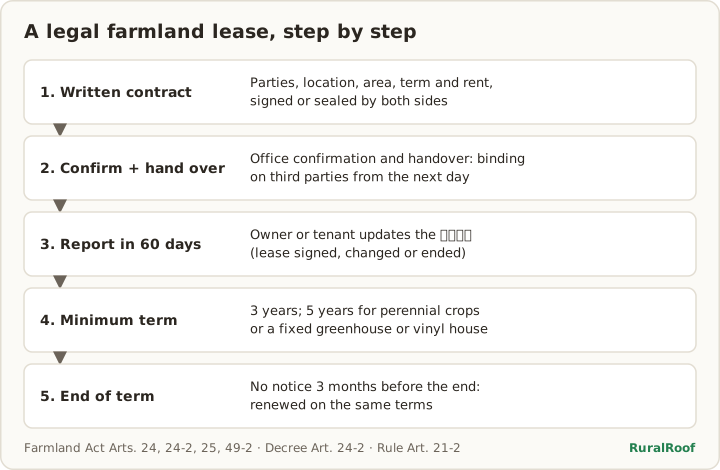
A written contract is the rule for leasing farmland to someone who will farm it (Art. 24(1)) [1]. The ministry may recommend a standard contract form (Rule Art. 21) [3].
To be confirmed at the office, the contract must be a complete document. It must state the parties, the location and area of the land, the term and the rent, and carry both signatures or seals (Rule Art. 21-2(2)) [3].
Confirmation gives the tenant protection. A lease confirmed by the city, district, town or township office binds third parties from the day after the land is handed over, even without registration (Art. 24(2)) [1].
The office records the contract in a lease confirmation ledger and stamps the confirmation date on it (Art. 24(3); Rule Art. 21-2(3)) [1] [3]. A third party who shows an interest may ask to view that ledger (Rule Art. 21-2(5)) [3].
A separate report is due as well. The owner or the tenant must apply to update the farmland register within 60 days of signing, changing or ending a lease (Art. 49-2) [1]. Not applying can cost up to 3 million won (Art. 64) [1].
How long must a farmland lease last?
At least 3 years. For land used for perennial crops, or where the tenant has put up a fixed greenhouse or vinyl house, the minimum is 5 years (Art. 24-2(1); Decree Art. 24-2(1)) [1] [2].
| Situation | Rule |
|---|---|
| Most leases | 3 years or more |
| Perennial crops, fixed greenhouse or vinyl house | 5 years or more |
| No term, or a shorter term | Treated as the minimum; the tenant may still rely on the shorter term |
| Second-crop lease (Art. 23(1)8) | Minimum term does not apply; up to 8 months |
| Renewal or new contract | The same minimums apply |
| No notice 3 months before the end | Renewed on the same terms |
The landlord may set a shorter term only for listed reasons. These include illness, call-up, study, election to public office, or a conversion permit for a project not yet started (Art. 24-2(3); Decree Art. 24-2(2)) [1] [2].
Renewal is automatic unless the landlord acts. If the landlord does not give notice of non-renewal or new terms 3 months before the end, the lease renews on the same terms (Art. 25) [1].
Terms that break the Act and harm the tenant have no effect (Art. 26-2) [1]. For example, a clause that cuts the term below the minimum against the tenant's wishes would fail.
What happens if a lease breaks the rules?
Penalties fall on both sides, and disputes have a set process. An illegal lease brings a fine of up to 20 million won, and a tenant who stops farming can be ordered out (Arts. 23(2), 61) [1].
If a tenant does not use the land for farming without good reason, the mayor or county head can order the lease to end (Art. 23(2)) [1]. The tenant must then end the contract within 3 months (Rule Art. 20-2(2)) [3].
Ignoring that order also carries a fine of up to 20 million won (Art. 61) [1]. The mayor or county head must tell the landlord at once (Rule Art. 20-2(3)) [3].
For disagreements on term or rent, either side can apply to the mayor or county head for mediation (Art. 24-3(1)) [1]. A three-member farmland lease mediation committee, chaired by the deputy mayor or deputy county head, handles it (Art. 24-3(4)) [1].
The committee must finish within 10 days of the application, extendable by up to 10 days (Decree Art. 24-3(6)) [2]. A proposal both sides accept becomes part of their contract (Art. 24-3(3)) [1].
What should a buyer of leased farmland check?
Check who farms the land and for how long. Whoever acquires leased farmland is treated as stepping into the landlord's place (Art. 26) [1], so the lease does not end with the sale.
Start with the farmland register. It records lease information, so ask the seller for a copy of each parcel, as the farmland register guide explains.
Then read the contract itself. Look at the term, the rent and the confirmation stamp. A confirmed lease with the land handed over binds you as the new owner from the day after handover (Art. 24(2)) [1].
Plan around the remaining term. If you want to farm the land yourself, the lease may run for years, and the landlord must give notice 3 months before the end to stop renewal (Arts. 24-2, 25) [1]. A sale order is covered in the farmland disposal order guide.
Buying farmland usually needs a farmland acquisition certificate first (Art. 8) [1]. The farmland acquisition certificate guide explains the process.
Leases are one of the checks in the rural house checklist. To look up a specific address, use address search, or browse rural listings.
Frequently Asked Questions
Is it legal to rent out farmland in Korea?
Only in the cases listed in Farmland Act Art. 23(1), such as inherited land, temporary absence, an owner aged 60 or over, or a 농지은행 trust lease [1]. Otherwise the fine is up to 20 million won (Art. 61) [1].
What is 농지은행 leasing?
The Korea Rural Community Corporation leases out farmland on the owner's behalf under a trust of 5 years or more (KRC Act Art. 24-4; Decree Art. 19-7) [4] [5]. An individual owner needs 3 years of ownership first (Farmland Act Art. 23(1)6) [1].
What is the minimum term for a farmland lease?
3 years, or 5 years for perennial crops or land with a fixed greenhouse or vinyl house (Art. 24-2; Decree Art. 24-2) [1] [2].
Can I lease farmland between individuals (개인간 농지 임대)?
Yes, if the owner fits an Art. 23(1) case, such as inheritance or an owner aged 60 or over [1]. The contract should be in writing, confirmed at the township office and reported to the 농지대장 within 60 days (Arts. 24, 49-2) [1].
Does a farmland lease survive a sale?
Yes. The buyer of leased farmland is treated as taking over the landlord's position (Art. 26) [1].
What happens if the landlord says nothing at the end of the term?
If the landlord gives no notice 3 months before the end, the lease renews on the same terms (Art. 25) [1].
Related articles
- Rural House Checklist for Korea: 8 Records to Check (2026)
- Landlocked Land (맹지) in Korea: Road Access Rules (2026)
- Korea's Rural Empty House Bank: How It Works (2026)
- Rural Second Home Tax in Korea: Keep One-Home Relief (2026)
- Nongmak vs Rural Stay Shelter in Korea: 2026 Farmland Rules
- Unregistered Buildings (미등기 건물) in Korea: Buyer Risks (2026)
- How to Read a Korean Property Register: 3 Records (2026)
- Korea's Empty House Law: Rural vs Urban Rules (2026)
- Korea Farmland Register (농지대장): Buyer's Guide 2026
- Farmland Acquisition Certificate (농취증) in Korea: 2026 Guide
- Build a House on Farmland in Korea: 2026 Permit Guide
- What Is a Farmhouse in Korea? 농가주택 Legal Meaning 2026
- Cheap Rural Houses in Korea: Real Prices and Costs (2026)
- Rural House Renovation Cost in Korea: Permits & Aid (2026)
- Free Empty House Rent in Rural Korea: What Exists (2026)
- Return-to-Farm Support in Korea: 2026 Loans and Grants
- Return-to-Farm Reality in Korea: 2026 Survey Numbers
- Farmland Disposal Order in Korea (농지 처분명령): 2026 Guide
- Rural House Acquisition Tax in Korea: 2026 Rates Guide
- Buying a House in South Korea as a Foreigner: 2026 Rules
- Alien Registration in Korea After Buying a House (2026)
- Cost of Living in South Korea 2026: Rural vs National
- Hanok Korean House: Buying and Restoring One (2026)
- Can Foreigners Buy Property in Japan? 2026 Akiya Bank Rules
General information, checked against the official sources below on the date shown. No sponsored content: no office, organization, agent or seller named here paid for or reviewed this page. Rules change, so confirm with the office named or a specialist (a licensed agent or a lawyer) before you sign.
Sources
- [1]농지법 (Farmland Act), Arts. 6, 10, 23, 24, 24-2, 24-3, 25, 26, 26-2, 49-2, 61, 64 and Addendum Art. 4 of Act No. 8352 (in force 2026-09-18) · Korea Ministry of Government Legislation (law.go.kr) · accessed 2026-11-04
- [2]농지법 시행령 (Farmland Act Enforcement Decree), Arts. 4, 9, 24, 24-2, 24-3 (in force 2026-09-18) · Korea Ministry of Government Legislation (law.go.kr) · accessed 2026-11-04
- [3]농지법 시행규칙 (Farmland Act Enforcement Rule), Arts. 20-2, 21, 21-2, 63 (in force 2026-09-22) · Korea Ministry of Government Legislation (law.go.kr) · accessed 2026-11-04
- [4]한국농어촌공사 및 농지관리기금법 (Korea Rural Community Corporation and Farmland Management Fund Act), Arts. 5-2, 19, 24-4 (in force 2026-07-07) · Korea Ministry of Government Legislation (law.go.kr) · accessed 2026-11-04
- [5]한국농어촌공사 및 농지관리기금법 시행령 (Enforcement Decree), Arts. 19-2, 19-3, 19-4, 19-5, 19-7, 19-8 (in force 2026-01-02) · Korea Ministry of Government Legislation (law.go.kr) · accessed 2026-11-04