How to Read a Korean Property Register: 3 Records (2026)
By the RuralRoof Editorial Team · Last updated 2026-11-01 · 14 official sources
A Korean property register tells you who owns a rural plot and who else has a claim on it. It does not tell you whether the house was built legally, or what you may do with the land. For that, you need two more records.
This guide reads all three field by field: the registry (등기부등본), the building register (건축물대장) and the land-use confirmation (토지이용계획확인서). Every field comes from the statute that defines it, and the rural red flags are marked. It does not walk through a real parcel, because the records name private owners.
- Read three records: the registry shows owners and claims, the building register shows the building and any violation, and the land-use confirmation shows zoning and limits [1] [4] [6].
- In the registry, the title section describes the property, section 갑구 records ownership, and section 을구 records other rights such as mortgages (Registration Act Art. 15) [1].
- Land and building have separate registry records, so pull both and compare the owners (Registration Act Art. 15) [1].
- Online, a registry certificate costs 1,000 won and a building register copy is free [2] [5].
Which three records should you read before buying?
The registry, the building register and the land-use confirmation. Each answers a different question, and no single one answers all three [1] [4] [6].
| Record | Question it answers | Kept or issued by | Where and fee |
|---|---|---|---|
| 등기사항증명서 (registry, commonly 등기부등본) | Who owns it, and who else has rights? | Court registry | 인터넷등기소: 700 won to view, 1,000 won to issue |
| 건축물대장 (building register) | What was built, and is it in violation? | County or city | 정부24: free online; in person 500 won to issue |
| 토지이용계획확인서 (land-use confirmation) | What zone is it, and what is restricted? | County or city | 토지이음 or the county; fee set by local ordinance |
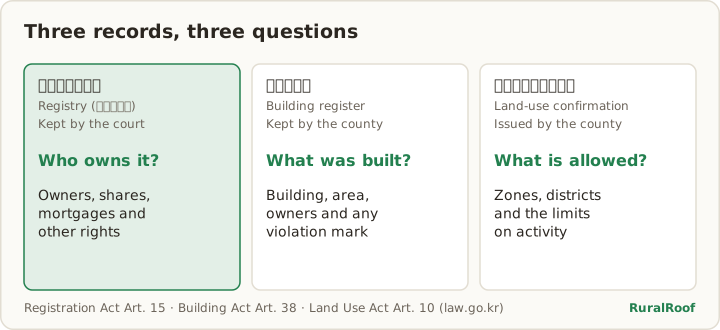
Anyone may view the registry or get a certificate on paying the fee, at any registry office (Registration Act Art. 19) [1]. In practice, you do not need the seller's permission to read it, so read it before you discuss a deposit.
How do you read the registry (등기부등본)?
Read it in three parts. The Registration Act splits each record into a title section (표제부), an ownership section (갑구) and a section for other rights (을구) (Art. 15) [1].
“The registration record shall have a title section recording the description of the real estate, section 갑 recording matters on ownership, and section 을 recording matters on rights other than ownership.”
For land, the title section records the address, parcel number, land category (지목) and area (Art. 34). For a building, it records the address, type, structure and area, including annexes (Art. 40) [1].
In sections 갑구 and 을구, each entry states a rank number, purpose, filing date and number, cause and holder (Art. 48). For co-owners, the record states each share (Art. 48(4)) [1].
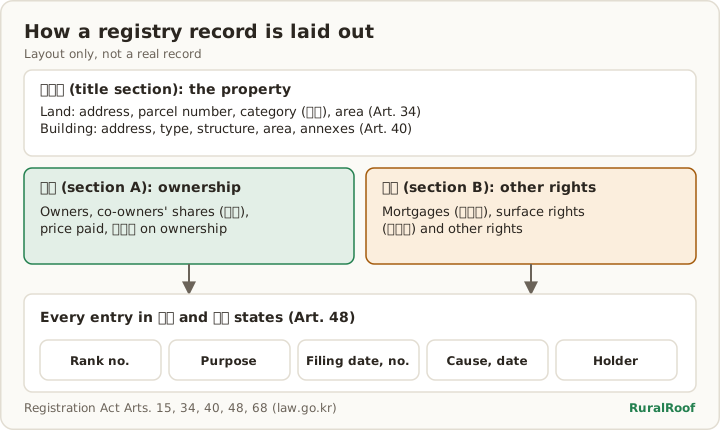
Rank decides priority. Within one section, the rank number decides; between sections, the filing number decides (Art. 4) [1]. For example, a mortgage in 을구 filed before a sale in 갑구 ranks ahead of it.
Section 갑구 can also show what the seller paid. For a reported sale, the registrar records the transaction price (Art. 68) [1].
Which registry entries are rural red flags?
Four matter most on a rural plot: a co-owned share (지분), a provisional registration (가등기), a maximum-amount mortgage (근저당) and a surface right (지상권) [1] [3].
| Entry | Where | What it means | Question to ask |
|---|---|---|---|
| 지분 (co-owned share) | 갑구 | A co-owner can sell their share, but cannot sell or change the whole without the others' consent (Civil Act Arts. 263, 264) | Are you buying the plot, or one share of it? |
| 가등기 (provisional registration) | 갑구 or 을구 | Protects a claim; a later main registration takes the provisional rank (Registration Act Arts. 88, 91) | Who holds it, and will it be removed before the balance? |
| 근저당 (maximum-amount mortgage) | 을구 | Secures debt up to a stated maximum; repaying debt before it is fixed does not end it (Civil Act Art. 357) | What is the maximum, and will it be cancelled at closing? |
| 지상권 (surface right) | 을구 | Lets another person use the land to own buildings, structures or trees (Civil Act Art. 279) | Who holds it, for what purpose and for how long? |
A provisional registration needs the most care. If its holder later completes the main registration, that registration takes the provisional rank (Art. 91) [1]. So it can rank ahead of a buyer who registered in between.
Also, a clean registry is not the whole story. A statutory surface right can arise when an auction leaves land and building with different owners (Civil Act Art. 366), and rights arising by law need no registration (Art. 187) [3].
So compare the owners on the land and building records. Where they differ, or where the building has no record at all, read the unregistered building guide first.
How do you read the building register (건축물대장)?
Check three things: that it exists, whether it carries a violation mark, and whether its area matches the site. The county keeps it to confirm a building's ownership, use and upkeep (Building Act Art. 38) [4].
Its contents are the building's description and its owners (Rules Art. 2) [5]. Annexes are written into the main building's register, not a separate one (Rules Art. 5) [5]. So a shed on site and missing here deserves a question.
Look above the page number on the first page. When a county issues a correction order, it must write "위반건축물" (violating building) there, with the date, the violation and the order in the changes section (Building Act Art. 79(4); Rules Art. 8) [4] [5].
That mark is removed once the violation is fixed or becomes lawful, and the changes section records this (Rules Art. 8) [5]. So read the changes section too: it shows the history.
Floor plans are restricted. A plan view needs the owner's consent or a listed exception, such as a person hired by the owner to broker the building, with proof (Rules Art. 11(3)) [5]. Ask the seller to arrange it.
How do you read the land-use confirmation (토지이용계획확인서)?
It lists the zones and districts covering a parcel, and the limits on activity in them (Land Use Act Art. 10) [6]. It answers what you may do with the land, not who owns it.
It also shows whether the parcel is in a land-transaction permit zone (Decree Art. 9(4)) [7]. Other listed items include a Building Act road and disadvantaged farmland (영농여건불리농지) (Rule Art. 2(2)) [8].
The road item is the one rural buyers should look for first, because a building site must generally touch a road for at least 2 m (Building Act Art. 44) [4]. The landlocked land guide explains the rule.
However, read it as a starting point. It names the zones, and a county official can tell you what they mean for your plan. For example, ask whether the house you have in mind could be extended or rebuilt there.
What does the land category (지목) tell you?
The registered use of the parcel. The law sets 28 categories (Spatial Data Act Art. 67) [9], and both the land ledger and the registry title section record the category (Art. 71; Registration Act Art. 34) [1] [9].
Rural buyers meet four often. 대 covers sites of permanent buildings such as homes; 전 is dry field; 답 is paddy; 임야 is forest and similar land (Decree Art. 58) [10].
However, a category does not settle whether land counts as farmland. The Farmland Act looks at actual use: land used for crops counts, whatever its legal category, with some exclusions (Art. 2) [11].
That matters because buying farmland generally needs a farmland acquisition certificate, with listed exceptions (Art. 8) [11]. See the farmland certificate guide before you buy any plot with a field on it.
How do you compare the three records?
Line up the same facts across the records. A mismatch in owner, area or structures is the signal to stop and ask, before any deposit.
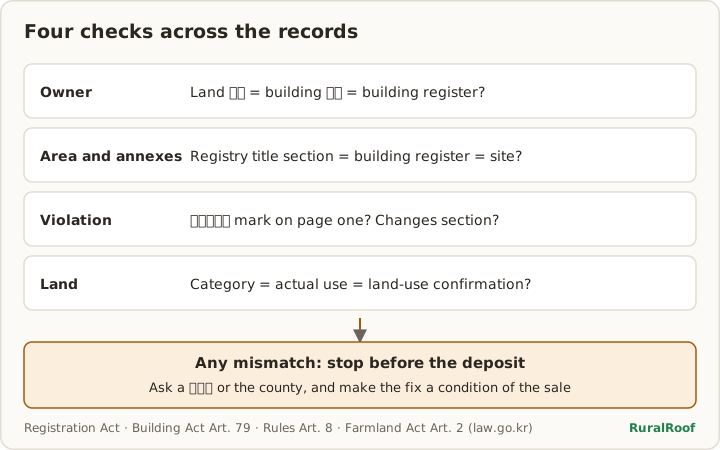
- Pull the land and building registry records from 인터넷등기소, and note every 갑구 and 을구 entry still in force [1] [12].
- Pull the building register from 정부24; check for the violation mark and read the changes section [5] [13].
- Pull the land-use confirmation from 토지이음; note each zone and any road or farmland item [6] [14].
- Compare owner, area and annexes across the records, then walk the site with the printouts in hand.
- Take each mismatch to the county building department or a 법무사, and make any fix a condition of the sale.
These records are part of the eight checks in the rural house checklist. For a specific address, use address search, or browse rural listings.
Frequently Asked Questions
What is 등기부등본 in Korean real estate?
The common name for the registry record of a property. The official document is the 등기사항증명서, and anyone can request one on paying the fee (Registration Act Art. 19) [1].
What is the difference between 갑구 and 을구?
Section 갑구 records ownership. Section 을구 records rights other than ownership, such as mortgages and surface rights (Registration Act Art. 15) [1].
How much does it cost to get these records?
Online, a registry view costs 700 won and a certificate 1,000 won; a building register copy is free. The land-use confirmation fee is set by local ordinance [2] [5] [6].
Do I need the owner's permission to read the registry?
No. Anyone may view the registry or get a certificate on paying the fee, and any registry office can handle the request (Registration Act Art. 19) [1].
What does 위반건축물 mean on a building register?
The county has issued a correction order. It writes this mark on the first page, and records the date, violation and order in the changes section (Rules Art. 8) [5].
What is a 근저당 on a Korean registry?
A mortgage securing debt up to a stated maximum. Repaying or transferring debt before the amount is fixed does not affect it (Civil Act Art. 357) [3].
Why is a 가등기 risky for a buyer?
It protects a claim on the property. If the holder later completes the main registration, that registration takes the rank of the 가등기 (Registration Act Art. 91) [1].
Can a co-owner sell me a whole rural plot?
No. A co-owner may sell their own share, but cannot dispose of the whole without the other co-owners' consent (Civil Act Arts. 263, 264) [3].
Related articles
- Rural House Checklist for Korea: 8 Records to Check (2026)
- Landlocked Land (맹지) in Korea: Road Access Rules (2026)
- Korea's Rural Empty House Bank: How It Works (2026)
- Rural Second Home Tax in Korea: Keep One-Home Relief (2026)
- Nongmak vs Rural Stay Shelter in Korea: 2026 Farmland Rules
- Unregistered Buildings (미등기 건물) in Korea: Buyer Risks (2026)
- Farmland Acquisition Certificate (농취증) in Korea: 2026 Guide
- Build a House on Farmland in Korea: 2026 Permit Guide
- What Is a Farmhouse in Korea? 농가주택 Legal Meaning 2026
- Cheap Rural Houses in Korea: Real Prices and Costs (2026)
- Rural House Renovation Cost in Korea: Permits & Aid (2026)
- Free Empty House Rent in Rural Korea: What Exists (2026)
- Return-to-Farm Support in Korea: 2026 Loans and Grants
- Return-to-Farm Reality in Korea: 2026 Survey Numbers
- Farmland Disposal Order in Korea (농지 처분명령): 2026 Guide
- Rural House Acquisition Tax in Korea: 2026 Rates Guide
- Buying a House in South Korea as a Foreigner: 2026 Rules
- Alien Registration in Korea After Buying a House (2026)
- Cost of Living in South Korea 2026: Rural vs National
- Hanok Korean House: Buying and Restoring One (2026)
- Can Foreigners Buy Property in Japan? 2026 Akiya Bank Rules
General information, checked against the official sources below on the date shown. No sponsored content: no office, organization, agent or seller named here paid for or reviewed this page. Rules change, so confirm with the office named or a specialist (a licensed agent or a lawyer) before you sign.
Sources
- [1]부동산등기법 (Real Estate Registration Act), Arts. 4, 15, 19, 34, 40, 48, 67, 68, 69, 75, 88, 91 (in force 2025-01-31) · Korea Ministry of Government Legislation (law.go.kr) · accessed 2026-11-01
- [2]등기사항증명서 등 수수료규칙 (Registry Certificate Fee Rules), Arts. 2, 3 (in force 2025-08-01) · Korea Ministry of Government Legislation (law.go.kr) · accessed 2026-11-01
- [3]민법 (Civil Act), Arts. 187, 263, 264, 279, 357, 366 (in force 2026-03-17) · Korea Ministry of Government Legislation (law.go.kr) · accessed 2026-11-01
- [4]건축법 (Building Act), Arts. 38, 44, 79 (in force 2026-02-27) · Korea Ministry of Government Legislation (law.go.kr) · accessed 2026-11-01
- [5]건축물대장의 기재 및 관리 등에 관한 규칙 (Building Register Rules), Arts. 2, 5, 8, 11, 27, 34 (in force 2025-07-31) · Korea Ministry of Government Legislation (law.go.kr) · accessed 2026-11-01
- [6]토지이용규제 기본법 (Framework Act on Land Use Regulation), Art. 10 (in force 2026-02-27) · Korea Ministry of Government Legislation (law.go.kr) · accessed 2026-11-01
- [7]토지이용규제 기본법 시행령 (Enforcement Decree), Art. 9 · Korea Ministry of Government Legislation (law.go.kr) · accessed 2026-11-01
- [8]토지이용규제 기본법 시행규칙 (Enforcement Rule), Art. 2 (in force 2022-03-30) · Korea Ministry of Government Legislation (law.go.kr) · accessed 2026-11-01
- [9]공간정보의 구축 및 관리 등에 관한 법률 (Spatial Data Act), Arts. 67, 71 (in force 2026-07-01) · Korea Ministry of Government Legislation (law.go.kr) · accessed 2026-11-01
- [10]공간정보의 구축 및 관리 등에 관한 법률 시행령 (Spatial Data Decree), Art. 58 (in force 2026-07-01) · Korea Ministry of Government Legislation (law.go.kr) · accessed 2026-11-01
- [11]농지법 (Farmland Act), Arts. 2, 8 (in force 2026-09-18) · Korea Ministry of Government Legislation (law.go.kr) · accessed 2026-11-01
- [12]인터넷등기소 (등기사항증명서 열람·발급) · Supreme Court of Korea, Registry Office · accessed 2026-11-01
- [13]정부24 (건축물대장 열람·발급) · Ministry of the Interior and Safety · accessed 2026-11-01
- [14]토지이음 (토지이용계획, 지적도) · MOLIT · accessed 2026-11-01