Korea Farmland Register (농지대장): Buyer's Guide 2026
By the RuralRoof Editorial Team · Last updated 2026-11-03 · 7 official sources
Korea's farmland register (농지대장) is the county record of every farm parcel: who owns it, who rents it and what stands on it. It replaced the older 농지원부 in 2022, and the rules changed with the name.
This guide explains what the farmland register records, how it differs from the 농지원부, who can get a copy, and what owners must report within 60 days. It ends with the checks a buyer should make before a deposit. Every rule comes from the Farmland Act or a ministry page.
- The 농지대장 is a per-parcel register of all farmland, kept by the city, district, town or township office where the land lies (Farmland Act Art. 49; Decree Art. 70) [1] [2].
- It replaced the 농지원부: records moved from per farmer to per parcel on 15 April 2022, and the name changed on 18 August 2022 [4] [5].
- On 정부24, only the owner or the tenant can get a copy: free online, or 500 won per parcel in person [6].
- Owners and tenants must report leases and new farm facilities within 60 days, or face a fine of up to 3 million won (Arts. 49-2, 64) [1].
What is the farmland register (농지대장)?
It is the official record of farmland ownership and use. The head of the city, district, town or township office must draw it up and keep it (Farmland Act Art. 49(1)) [1].
The register exists so the state can see who owns farmland and how it is used, and manage it well (Art. 49(1)) [1]. It is drawn up for every piece of farmland, parcel by parcel (Decree Art. 70) [2].
“The farmland register shall include the location, parcel number, land category, area, owner, lease information and whether the land is in an agricultural promotion area, among other details.”
The office must update the register without delay when its contents change (Art. 49(4)). It may ask the owner to report, or send an official to check the land (Art. 49(3)) [1].
A computer file of the register counts as the register itself (Art. 49(5)) [1]. The register is kept that way, and 정부24 issues copies online, as covered below [6].
How is 농지대장 different from 농지원부?
They are the old and new names for the same record, but the record changed. The 농지원부 was kept per farmer; the 농지대장 is kept per parcel, for all farmland [4] [5].
| 농지원부 (before) | 농지대장 (now) | |
|---|---|---|
| Unit of record | Per farmer (농업인별) | Per parcel (필지별) |
| Which land | Farmland of 1,000㎡ (about 10,760 ft²) or more | All farmland, no minimum area |
| Office in charge | Where the farmer lives | Where the land lies |
| Lease and facility reports | Not required | Required within 60 days |
The ministry announced the per-parcel switch on 13 October 2021. It took effect on 15 April 2022, and dropped the old 1,000㎡ minimum [4].
The new name came with the 2021 Farmland Act amendment (Act No. 18401). Its register articles took effect one year after promulgation, which the ministry gives as 18 August 2022 (Addendum Art. 1) [1] [5].
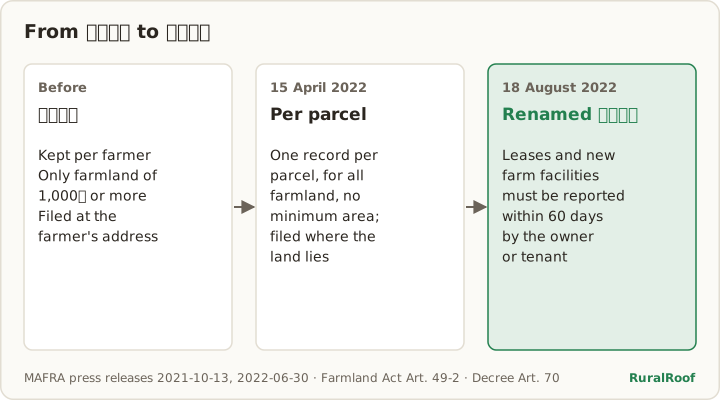
The ministry said old 농지원부 records would be copied and kept for 10 years, so farmers could still request them [4]. In practice, ask the township office if you need a pre-2022 record.
What does the farmland register record?
The law lists the core fields: location, parcel number, land category, area, owner, lease information and agricultural promotion area status (Art. 49(2)) [1]. Each field answers a buyer's question.
| Field | What it tells you | Compare it with |
|---|---|---|
| Location, parcel number | Which parcel the record covers | The registry and the listing |
| Land category (지목), area | The registered use and size | The registry title section |
| Owner | Who the county has as owner | The registry ownership section (갑구) |
| Lease information | Whether someone rents or borrows the land | What the seller tells you |
| Agricultural promotion area | Whether stricter farmland zoning applies | The land-use confirmation |
| Facilities | Reported sheds, barns or greenhouses | What stands on site |
Facilities enter the register through change reports. When an owner or tenant reports a farm facility, the office checks the building or temporary-building record through shared government data (Rule Art. 57-2(2)) [3].
Surveys feed it too. Counties must survey farmland ownership and use, and have the results reflected in the farmland register (Art. 54(1), (9)) [1].
However, the register is not a title document. Ownership itself is shown in the court registry, which the guide to Korean property records explains field by field.
Who can get a copy of the farmland register, and how?
On 정부24, only the owner or the tenant recorded on the register can get a copy. You need a digital certificate to prove who you are [6].
| Route | Who may apply | Fee |
|---|---|---|
| 정부24 online | Owner or tenant only; no proxy online | Free |
| City, district, town or township office | Owner or tenant, or their proxy | 500 won per parcel |
At the office, 정부24 lists a copy as immediate, within 3 working hours. If the record first needs a new entry or a correction, it lists 10 days in total [6].
The rule allows an oral or written request, including electronic documents (Rule Art. 58(1)). Viewing the register itself takes place in the office, with an official present (Art. 58(2)) [3].
Staff who handle the register must not disclose its contents to others (Rule Art. 56(3)) [3]. So, in practice, a buyer cannot simply look up a stranger's parcel [6].
What must owners and tenants report within 60 days?
Four kinds of change. The owner or tenant must apply to update the register within 60 days of the change (Farmland Act Art. 49-2) [1].
- A lease or use loan (사용대차) of the farmland is signed, changed or ended [1].
- A farm production facility is installed, such as a greenhouse, barn, insect-rearing house or 농막 (Art. 2(1)(b); Decree Art. 2(3)) [1] [2].
- A convenience facility for farm work is installed: a toilet, a car park or a rural stay shelter (농촌체류형 쉼터) (Art. 2(1)(c); Decree Art. 2(4)) [1] [2].
- Any other case set by ministry ordinance [1].
The process uses one form, the 농지대장 이용정보 변경신청서. For a lease, attach the lease or use-loan contract, and file it with the office where the land lies (Rule Art. 57-2(1)) [3]. There is no fee [7].
The duty covers leases signed, changed or ended, and facilities installed, from 18 August 2022 [5] [7]. It applies to the owner or the tenant, so either side can file.
What should a buyer check in the farmland register?
Check that it matches the other records and the site. A gap in owner, area, lease or facilities is a question to settle before you pay a deposit.
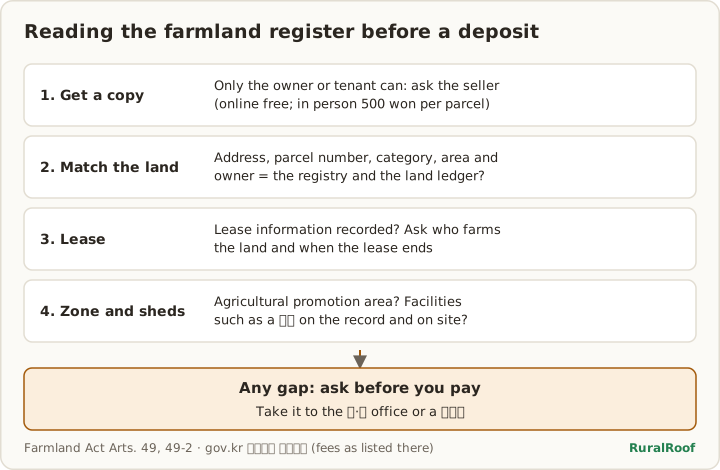
Start with the owner and area. The register lists them (Art. 49(2)) [1], so compare them with the court registry. If they differ, ask the township office which record is out of date.
Then read the lease information. A recorded lease means someone else may be farming the land, so ask the seller who it is and when the lease ends.
Next, check the agricultural promotion area entry. The register records it (Art. 49(2)) [1], and it signals stricter farmland zoning. Confirm what it allows with the county before you plan any building.
Finally, walk the site. A 농막 or greenhouse on the land should match a reported facility. For the shed rules, see the farm shed guide.
How does the register relate to the farmland certificate and 자경증명?
They are separate documents from the same office. The register records the land; the farmland acquisition certificate lets you buy it; the 자경증명 proves that a farmer farms it personally [1] [3].
Buying farmland generally needs a farmland acquisition certificate, with listed exceptions (Art. 8) [1]. The farmland acquisition certificate guide explains who qualifies and how to apply.
A self-farming farmer or farm corporation can ask for a 자경증명 (Art. 50(2)) [1]. The office checks the farming situation and, if self-farming is clear, issues it within 7 days of the application (Rule Art. 59(2)) [3].
After you buy, the register follows you. The office updates it when its contents change (Art. 49(4)) [1], and any later lease or new shed is yours to report within 60 days.
The register is one of the checks in the rural house checklist. To look up a specific address, use address search, or browse rural listings.
Frequently Asked Questions
What is 농지대장 in English?
It is usually called the farmland register or farmland ledger. It records each parcel's location, category, area, owner, lease information and agricultural promotion area status (Farmland Act Art. 49(2)) [1].
Is 농지원부 still issued?
The record was renamed 농지대장 from 18 August 2022 [5]. The ministry said old 농지원부 records would be kept for 10 years so farmers could still request them [4].
Can I get the farmland register for land I want to buy?
Not by yourself on 정부24: only the owner or the tenant can get a copy [6]. Ask the seller to issue one and give it to you.
How much does a 농지대장 copy cost?
On 정부24 it is free. At a city, district, town or township office it costs 500 won per parcel [6].
Where do I apply to change the farmland register?
At the city, district, town or township office where the land lies, with form 58-2 and, for a lease, the contract (Rule Art. 57-2) [3]. 정부24 also takes it online, with no fee [7].
What is the deadline to report a farmland lease?
60 days from the day the lease is signed, changed or ended. The owner or the tenant must apply (Farmland Act Art. 49-2) [1].
Related articles
- Rural House Checklist for Korea: 8 Records to Check (2026)
- Landlocked Land (맹지) in Korea: Road Access Rules (2026)
- Korea's Rural Empty House Bank: How It Works (2026)
- Rural Second Home Tax in Korea: Keep One-Home Relief (2026)
- Nongmak vs Rural Stay Shelter in Korea: 2026 Farmland Rules
- Unregistered Buildings (미등기 건물) in Korea: Buyer Risks (2026)
- How to Read a Korean Property Register: 3 Records (2026)
- Korea's Empty House Law: Rural vs Urban Rules (2026)
- Farmland Acquisition Certificate (농취증) in Korea: 2026 Guide
- Build a House on Farmland in Korea: 2026 Permit Guide
- What Is a Farmhouse in Korea? 농가주택 Legal Meaning 2026
- Cheap Rural Houses in Korea: Real Prices and Costs (2026)
- Rural House Renovation Cost in Korea: Permits & Aid (2026)
- Free Empty House Rent in Rural Korea: What Exists (2026)
- Return-to-Farm Support in Korea: 2026 Loans and Grants
- Return-to-Farm Reality in Korea: 2026 Survey Numbers
- Farmland Disposal Order in Korea (농지 처분명령): 2026 Guide
- Rural House Acquisition Tax in Korea: 2026 Rates Guide
- Buying a House in South Korea as a Foreigner: 2026 Rules
- Alien Registration in Korea After Buying a House (2026)
- Cost of Living in South Korea 2026: Rural vs National
- Hanok Korean House: Buying and Restoring One (2026)
- Can Foreigners Buy Property in Japan? 2026 Akiya Bank Rules
General information, checked against the official sources below on the date shown. No sponsored content: no office, organization, agent or seller named here paid for or reviewed this page. Rules change, so confirm with the office named or a specialist (a licensed agent or a lawyer) before you sign.
Sources
- [1]농지법 (Farmland Act), Arts. 2, 8, 49, 49-2, 50, 54, 64 and Addendum Art. 1 of Act No. 18401 (in force 2026-09-18) · Korea Ministry of Government Legislation (law.go.kr) · accessed 2026-11-03
- [2]농지법 시행령 (Farmland Act Enforcement Decree), Arts. 2, 70, 80 (in force 2026-09-18) · Korea Ministry of Government Legislation (law.go.kr) · accessed 2026-11-03
- [3]농지법 시행규칙 (Farmland Act Enforcement Rule), Arts. 55, 56, 57-2, 58, 59 (in force 2026-09-22) · Korea Ministry of Government Legislation (law.go.kr) · accessed 2026-11-03
- [4]2022년 4월 15일부터 농가별로 작성하던 농지원부 필지별로 작성 (press release, 2021-10-13) · Ministry of Agriculture, Food and Rural Affairs (mafra.go.kr) · accessed 2026-11-03
- [5]「2022년 하반기부터 이렇게 달라집니다」: 농지 임대차계약 등 농지대장 변경신청 의무화 시행 (2022-06-30) · Ministry of Agriculture, Food and Rural Affairs (mafra.go.kr) · accessed 2026-11-03
- [6]농지대장 등본발급 (service page) · Ministry of the Interior and Safety, 정부24 (gov.kr) · accessed 2026-11-03
- [7]농지대장 이용정보 변경신청 (service page) · Ministry of the Interior and Safety, 정부24 (gov.kr) · accessed 2026-11-03