Korea's Empty House Law: Rural vs Urban Rules (2026)
By the RuralRoof Editorial Team · Last updated 2026-11-02 · 4 official sources
Korea's empty house law is really two laws. The 빈집 특례법 (Special Act on Empty Houses) is the one people search for, but it does not cover most rural houses. In rural areas, the Rural Community Improvement Act (농어촌정비법) does.
This guide explains where each law applies, what counts as an empty house, when a county can order repairs or demolition, and what the fines are. Every rule comes from the statute text. The last section turns it into questions to ask before you buy.
- Rural empty houses fall under the 농어촌정비법; the 빈집 특례법 excludes its empty house projects in rural and semi-rural areas (Special Act Art. 3(2)) [1].
- A house becomes a legal 빈집 when nobody has lived in or used it for 1 year from the date the county confirmed this (Rural Act Art. 2) [2].
- A county can order repair or demolition of a hazardous empty house, with 60 days to comply (Rural Act Art. 65-5) [2].
- Ignoring a demolition order can cost 5,000,000 won, up to twice a year (Rural Act Art. 133; Decree Art. 98) [2] [3].
Which law covers an empty house in rural Korea?
The Rural Community Improvement Act (농어촌정비법). The Special Act on Empty Houses states that its empty house projects do not apply in rural and semi-rural areas (Art. 3(2)) [1].
“The empty house improvement projects and self-initiated housing improvement projects under this Act shall not apply in rural and semi-rural areas under Article 2(1) and (2) of the Rural Community Improvement Act.”
There is one exception. The Special Act still applies to self-initiated housing projects inside an urban regeneration area (Art. 3(2)) [1]. For a buyer of a single rural house, the rural law is the one to read.
| Point | 빈집 특례법 (urban) | 농어촌정비법 (rural) |
|---|---|---|
| Where it applies | Outside rural and semi-rural areas (Art. 3(2)) | Rural and semi-rural areas (Art. 2) |
| What can be a 빈집 | A house (주택), minus unsold new homes and other listed exclusions (Art. 2) | A rural house or building (Art. 2) |
| County plan | Every 5 years (Art. 4) | A 5-year plan, plus a yearly action plan (Art. 64) |
| Order to fix or demolish | 60 days to comply (Art. 11) | 60 days, one 60-day extension (Art. 65-5) |
| Fine for ignoring an order | Up to half the per-m² standard value times floor area (Art. 65) | 5,000,000 won (demolition) or 2,000,000 won (other) (Art. 133; Decree Art. 98) |
| Owner can ask the county to buy | Yes, answer within 30 days (Art. 11-2) | No matching clause (Art. 65-6) |
How do you know if a house is in a rural area?
Look at the address. Every 읍 and 면 is rural, and so is any other area the Ministry of Agriculture (MAFRA) designates (Framework Act Art. 3(5)) [4].
The rural law counts farming and fishing villages as 농어촌 (Rural Act Art. 2(1)) [2]. It adds a semi-rural class, 준농어촌: parts of a metropolitan city's 구 that sit in a farmland promotion zone or a greenbelt (Art. 2(2)) [2].
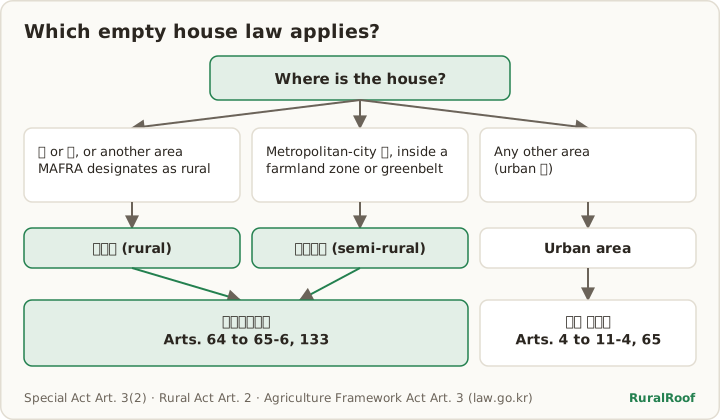
In practice, most houses on rural listings sit in a 읍 or 면, so the rural law applies. A house in an urban 동 falls under the Special Act unless MAFRA has designated that area as rural [1] [4].
If the address is unclear, enter it in address search. The result shows the 읍, 면 or 동, and the county can confirm any designation.
What counts as an empty house (빈집) under Korean law?
A rural house or building that nobody has lived in or used for 1 year or more, counted from the day the county confirmed it (Rural Act Art. 2(12)) [2].
So vacancy alone is not enough. The clock starts when the 시장, 군수 or 구청장 checks whether anyone lives in or uses the building [2]. A house empty for years is not a legal 빈집 until that check.
The urban definition is similar but narrower. It covers houses only, and leaves out unsold new homes and other types set by decree (Special Act Art. 2) [1].
To find empty houses, the county runs a survey covering location, upkeep, how long each house has been empty, and its owners and rights (Rural Act Art. 64-2) [2]. Staff may enter a property after giving the owner 7 days' notice (Art. 64-3) [2].
What must a county do about rural empty houses?
Plan, survey and act. The county must make a 5-year empty house plan and a yearly action plan (Rural Act Art. 64) [2].
The plan covers how houses will be demolished, rebuilt, repaired or reused, the funding, and buying houses for reuse. It is adopted after hearing residents and a local policy committee, and then published (Art. 64) [2].
A county may also mark a priority empty house zone (빈집우선정비구역) where empty houses are rising or common, and no other redevelopment project is under way (Art. 64-7) [2].
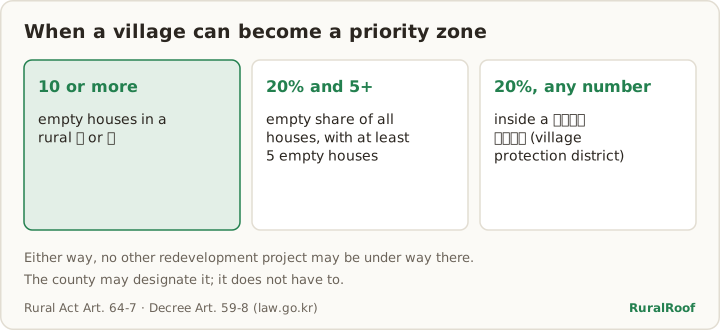
The decree sets the numbers. A rural 동 or 리 qualifies with 10 or more empty houses, or with at least 5 empty houses making up 20% or more of all homes (Decree Art. 59-8) [3].
Inside a village protection district (농촌마을보호지구), a 20% empty share is enough, even with fewer than 5 houses (Decree Art. 59-8) [3].
When can a county order an empty house demolished?
When it is a 특정빈집: an empty house that risks collapse, fire or crime, harms hygiene, badly spoils the scenery, or is unfit to leave in its setting (Rural Act Art. 65-3) [2].
Anyone may report such a house to the county, which must survey the site within 30 days of the report (Art. 65-3; Decree Art. 60) [2] [3]. The county first gives guidance, such as removing hazards or cutting trees (Art. 65-4) [2].
Next comes an order. After review by the local building committee, the county can order demolition, rebuilding or repair. The owner has 60 days, with one 60-day extension for unavoidable reasons such as natural disasters (Art. 65-5) [2].
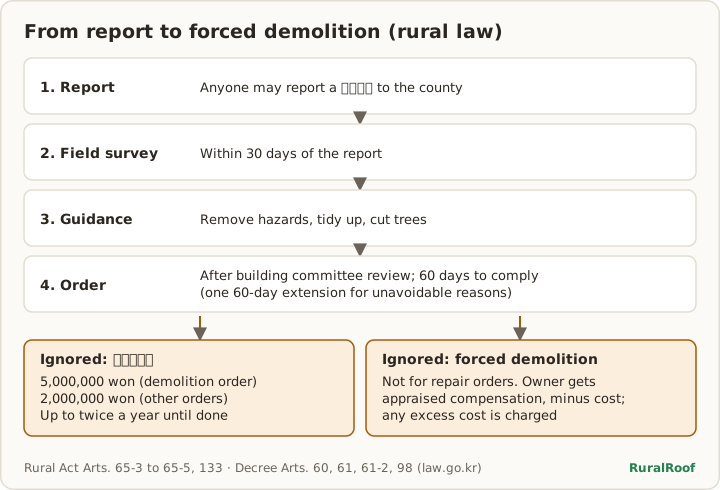
If the owner ignores the order, the county can demolish the house itself, except under a repair or rebuild order, and charge the cost (Art. 65-5(2)) [2]. It must send a notice at least 7 days before (Decree Art. 61) [3].
What are the fines and compensation?
The fine (이행강제금) is 5,000,000 won for ignoring a demolition order and 2,000,000 won for other orders. A local ordinance may cut it by up to half (Rural Act Art. 133; Decree Art. 98) [2] [3].
The county can impose it up to twice a year, counted from the first order, until the owner complies (Art. 133(2)) [2]. So an ignored demolition order can cost up to 10,000,000 won a year.
If the county demolishes a house itself, it must pay fair compensation. The amount is the average of at least two certified appraisals, valued at the date the owner was notified (Rural Act Art. 65-5(4); Decree Art. 61-2) [2] [3].
The owner may nominate one appraiser within 14 days of the notice (Decree Art. 61-2(2)) [3]. The county may deduct the demolition cost, and collect the difference if the cost is higher (Art. 65-5(4)) [2].
Can the county buy a rural empty house?
Yes, under its empty house plan. A province, county or listed agency may buy an empty house and its land for public use, rental housing or farm and fishery workers' housing (Rural Act Art. 65-6) [2].
The listed agencies include the Korea Rural Community Corporation (한국농어촌공사) and local public corporations. The price is the average of at least two certified appraisals, and the owner may nominate one appraiser (Decree Art. 61-3) [3].
However, the rural law gives owners no right to ask for a purchase. The urban Special Act does: an owner may request it, and the authority must answer within 30 days (Special Act Art. 11-2) [1]. Article 65-6 of the rural law has no matching clause [2].
How bought houses are used and what rent is charged is set by local ordinance (Art. 65-6(4)) [2]. The empty house rental guide covers the county schemes that rent them out.
What does the empty house law mean for a buyer?
Three things. You inherit the owner's duty to look after the house, you should check for open county orders, and an empty house may qualify for county programmes.
The law makes owners keep an empty house from harming its surroundings (Rural Act Art. 65) [2]. An order is addressed to the owner, so ask the county building department whether any guidance, order or fine is open on the house before you sign.
A rural house owner can be named to carry out empty house work, house improvement or slate roof removal under a county project (Art. 56(1)) [2]. The rural housing improvement fund can give grants or loans to people who want to improve a rural house (Art. 67) [2].
In a priority zone, an empty house being rebuilt or converted under such a project may get relief from some building rules it fails only because the law changed. The relief stays within the old house's scope and needs building committee review (Art. 64-8) [2].
Ask the county whether your village is a priority zone before you plan any rebuild.
- Check the address: a 읍 or 면 means the rural law applies [2] [4].
- Ask the county whether the house is on its empty house survey or has a 특정빈집 report, guidance or order [2].
- Ask whether any 이행강제금 has been imposed, and get it settled before closing [2] [3].
- Ask whether the village is a priority empty house zone, and which programmes cover it [2].
- Read the registry, building register and land-use confirmation, as in the property records guide.
Rural empty houses for sale are listed in the empty house bank guide and in rural listings. Before any deposit, work through the rural house checklist.
Frequently Asked Questions
Does the 빈집 특례법 apply to rural houses?
Not for empty house projects. Article 3(2) excludes them in rural and semi-rural areas, where the 농어촌정비법 applies instead [1] [2].
How long must a house be empty to count as a 빈집?
One year or more with nobody living in or using it, counted from the day the county confirmed this (Rural Act Art. 2(12)) [2].
What is a 특정빈집?
An empty house that risks collapse, fire or crime, harms hygiene, badly spoils the scenery, or is unfit to leave as it is. The county can order action on it (Rural Act Arts. 65-3, 65-5) [2].
How much is the fine for ignoring an empty house order?
In rural areas, 5,000,000 won for a demolition order and 2,000,000 won for other orders, up to twice a year. A local ordinance may cut it by up to half (Art. 133; Decree Art. 98) [2] [3].
Can the county demolish my rural house without paying?
No. It must pay compensation based on at least two appraisals, but may deduct the demolition cost and collect any excess (Rural Act Art. 65-5; Decree Art. 61-2) [2] [3].
Related articles
- Rural House Checklist for Korea: 8 Records to Check (2026)
- Landlocked Land (맹지) in Korea: Road Access Rules (2026)
- Korea's Rural Empty House Bank: How It Works (2026)
- Rural Second Home Tax in Korea: Keep One-Home Relief (2026)
- Nongmak vs Rural Stay Shelter in Korea: 2026 Farmland Rules
- Unregistered Buildings (미등기 건물) in Korea: Buyer Risks (2026)
- How to Read a Korean Property Register: 3 Records (2026)
- Farmland Acquisition Certificate (농취증) in Korea: 2026 Guide
- Build a House on Farmland in Korea: 2026 Permit Guide
- What Is a Farmhouse in Korea? 농가주택 Legal Meaning 2026
- Cheap Rural Houses in Korea: Real Prices and Costs (2026)
- Rural House Renovation Cost in Korea: Permits & Aid (2026)
- Free Empty House Rent in Rural Korea: What Exists (2026)
- Return-to-Farm Support in Korea: 2026 Loans and Grants
- Return-to-Farm Reality in Korea: 2026 Survey Numbers
- Farmland Disposal Order in Korea (농지 처분명령): 2026 Guide
- Rural House Acquisition Tax in Korea: 2026 Rates Guide
- Buying a House in South Korea as a Foreigner: 2026 Rules
- Alien Registration in Korea After Buying a House (2026)
- Cost of Living in South Korea 2026: Rural vs National
- Hanok Korean House: Buying and Restoring One (2026)
- Can Foreigners Buy Property in Japan? 2026 Akiya Bank Rules
General information, checked against the official sources below on the date shown. No sponsored content: no office, organization, agent or seller named here paid for or reviewed this page. Rules change, so confirm with the office named or a specialist (a licensed agent or a lawyer) before you sign.
Sources
- [1]빈집 및 소규모주택 정비에 관한 특례법 (Special Act on Empty Houses and Small-Scale Housing), Arts. 1, 2, 3, 4, 5, 11, 11-2, 11-3, 65 (in force 2026-07-01) · Korea Ministry of Government Legislation (law.go.kr) · accessed 2026-11-02
- [2]농어촌정비법 (Rural Community Improvement Act), Arts. 2, 56, 64, 64-2, 64-3, 64-7, 64-8, 65, 65-3, 65-4, 65-5, 65-6, 67, 133 (in force 2026-09-11) · Korea Ministry of Government Legislation (law.go.kr) · accessed 2026-11-02
- [3]농어촌정비법 시행령 (Enforcement Decree), Arts. 59-8, 60, 61, 61-2, 61-3, 98 (in force 2026-09-18) · Korea Ministry of Government Legislation (law.go.kr) · accessed 2026-11-02
- [4]농업ㆍ농촌 및 식품산업 기본법 (Framework Act on Agriculture, Rural Community and Food Industry), Art. 3 (in force 2026-07-01) · Korea Ministry of Government Legislation (law.go.kr) · accessed 2026-11-02