Farmland Capital Gains Tax in Korea: 8-Year Relief (2026)
By the RuralRoof Editorial Team · Last updated 2026-11-06 · 4 official sources
Farmland capital gains tax in Korea can be zero, or reach 55% in the top bracket. The difference comes down to two questions: did the owner live near the land, and did they farm it themselves?
This guide explains the rates, the non-business land surcharge and the 8-year self-farming relief (자경농지 감면). It also covers the relief caps, inherited and rezoned land, and how to claim. Every rule comes from a statute on law.go.kr, read on 6 November 2026.
- Land held 2 years or more is taxed at the basic rates of 6% to 45% on the tax base, after a long-term holding deduction of 6% to 30% for land held 3 years or more [3].
- Farmland is non-business land if the owner did not live nearby and farm it for long enough. Non-business land pays 10 percentage points more, from 16% to 55% [3] [4].
- Owners who lived nearby and farmed the land themselves for 8 years or more get 100% of the tax relieved (Restriction of Special Taxation Act Art. 69) [1] [2].
- The relief is capped at 100 million won of tax per tax year and 200 million won over 5 tax years, and must be claimed with the tax return [1] [2].
How is capital gains tax on farmland calculated?
The gain is cut by a long-term holding deduction and a basic deduction, then taxed at the rates in the Income Tax Act. A return is due within 2 months of the end of the month of sale [3].
First comes the long-term holding deduction. Land held for 3 years or more deducts 6% of the gain, rising 2 points a year to 30% at 15 years (Income Tax Act Art. 95(2), Table 1) [3].
The listed exclusions from that deduction are unregistered assets and certain houses, so farmland held 3 years or more qualifies (Art. 95(2)) [3]. Then a basic deduction of 2.5 million won a year applies (Art. 103(1)) [3].
The tax base is then taxed at the rates in Art. 104 [3]. For land held 2 years or more, these are the basic income tax rates of Art. 55(1), from 6% to 45% [3].
Short holding periods cost more. Land held under 1 year is taxed at 50%, and land held 1 to 2 years at 40% (Art. 104(1)2, 3) [3]. Where two rates could apply, the higher tax wins (Art. 104(1)) [3].
The seller files a preliminary return within 2 months from the end of the month of the sale (Art. 105(1)1) [3]. In practice, a certified tax accountant (세무사) usually prepares it.
What are the farmland capital gains tax rates in 2026?
From 6% to 45% for ordinary land held 2 years or more, and from 16% to 55% for non-business land. Each rate applies to the slice of the tax base inside its bracket [3].
| Tax base (won) | Basic rate | Non-business land |
|---|---|---|
| Up to 14 million | 6% | 16% |
| 14 million to 50 million | 15% | 25% |
| 50 million to 88 million | 24% | 34% |
| 88 million to 150 million | 35% | 45% |
| 150 million to 300 million | 38% | 48% |
| 300 million to 500 million | 40% | 50% |
| 500 million to 1 billion | 42% | 52% |
| Over 1 billion | 45% | 55% |
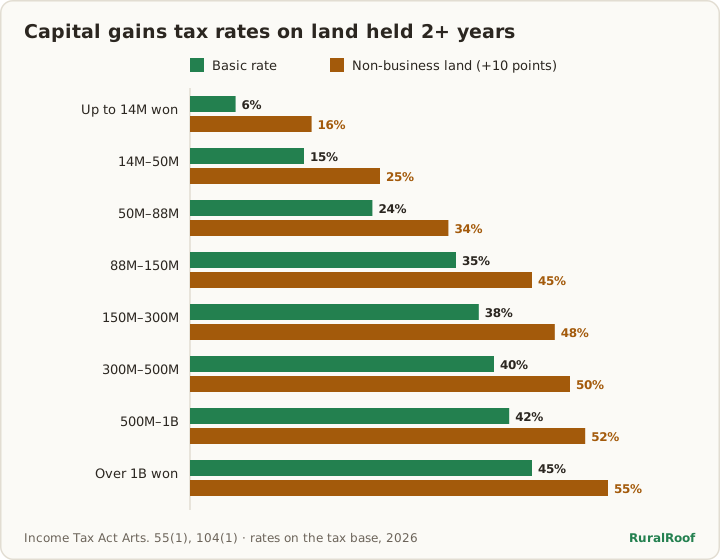
The non-business rate adds 10 percentage points to every bracket (Art. 104(1)8) [3]. Non-business land in a designated area can carry a further 10 points (Art. 104(4)3) [3].
When does farmland count as non-business land?
When the owner did not live in the farmland's area or did not farm it personally, for long enough during ownership (Income Tax Act Art. 104-3(1)1) [3] [4].
Living in the area (재촌) means living in the city, county or district where the land is, in an adjacent one, or within 30 km of the land in a straight line (Income Tax Decree Arts. 153(3), 168-8(2)) [4].
Farming personally (자경) uses the same test as the relief. You farm full-time, or do at least half of the farm work with your own labour (Decree Art. 168-8(2); Special Taxation Decree Art. 66(13)) [2] [4].
The status is judged over set periods. For land owned 5 years or more, it is non-business only if all three are true (Income Tax Decree Art. 168-6) [4]:
- It failed the use test for more than 2 of the 5 years before the sale.
- It failed the test for more than 1 of the 3 years before the sale.
- It failed the test for more than 40% of the time it was owned.
Farmland inside the urban area (도시지역) of a city is also non-business, except green zones and development-restriction zones (Art. 104-3(1)1(b); Decree Art. 168-8(4)) [3] [4]. Town (eup) and township (myeon) areas of mixed urban-rural cities are excluded from this rule.
Which farmland is not treated as non-business land?
The Decree states a list of farmland that is never non-business, even without living nearby and farming. Several items matter to rural buyers and heirs (Income Tax Decree Arts. 168-8(3), 168-14(3)) [4].
| Case | Condition | Rule |
|---|---|---|
| Inherited farmland | Within 3 years of the start of inheritance | Art. 168-8(3)2 |
| Former farmer's land | Within 3 years of leaving farming | Art. 168-8(3)3 |
| KRC trust lease | Entrusted by an individual to the KRC and leased for 8 years or more | Art. 168-8(3)9 |
| Illness, old age, call-up | Lived nearby and farmed it 5+ years before; still lives there; land leased legally | Art. 168-8(3)7 |
| Farmed by a parent or spouse | They lived nearby and farmed it 8+ years; you inherited it or received it as a gift; not in an urban area at sale | Art. 168-14(3)1-2 |
How does the 8-year self-farming relief work?
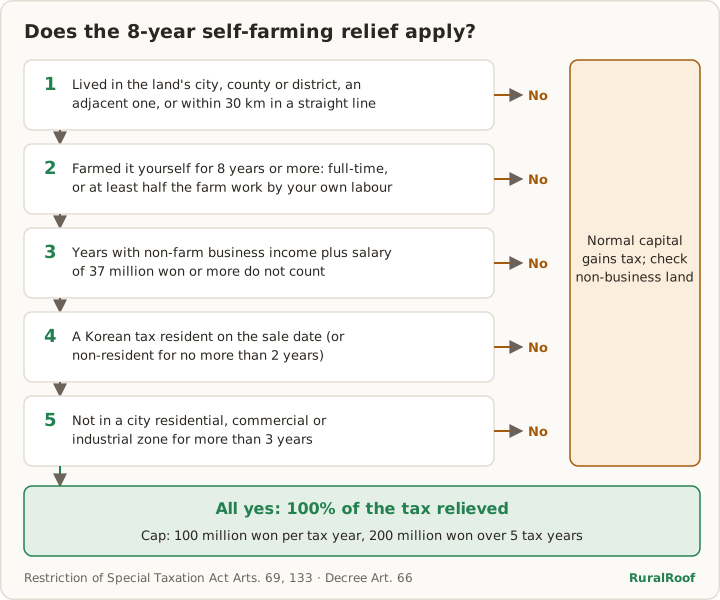
It removes 100% of the capital gains tax on farmland the owner farmed personally for 8 years or more while living nearby (Restriction of Special Taxation Act Art. 69(1)) [1].
“For income from the transfer of land that was directly cultivated in the manner set by Presidential Decree, tax equal to 100/100 of the capital gains tax shall be reduced.”
According to the Decree, four conditions apply to the seller. The first is about where you lived: in the land's city, county or district, an adjacent one, or within 30 km in a straight line (Decree Art. 66(1)) [2].
Second, you farmed the land yourself for 8 years or more between buying and selling it. Farming means working full-time, or doing at least half of the work with your own labour (Art. 66(4), (13)) [2].
Third, some years do not count. A year in which non-farm business income plus salary reached 37 million won or more is removed from the farming period (Art. 66(14)1) [2]. So does a year with high non-farm business revenue (Art. 66(14)2) [2].
Fourth, on the sale date you must be a Korean tax resident, or have become a non-resident no more than 2 years before (Art. 66(1)) [2]. This matters for owners who move abroad.
How much tax can the self-farming relief remove?
Up to 100 million won of tax in one tax year, and 200 million won across 5 tax years. Tax above those caps is payable (Restriction of Special Taxation Act Art. 133(1)) [1].
The 5-year cap counts the relief in the year of sale plus the relief received in the 4 tax years before it (Art. 133(1)2) [1]. It is shared with several other land reliefs listed in the same article [1].
Splitting a sale does not reset the annual cap. If you divide land within 1 year before selling part of it, then sell the rest to the same buyer or their spouse within 2 years, both count as one tax year (Art. 133(3)) [1].
The basic deduction works in your favour here. The 2.5 million won deduction is taken first from gains that are not relieved (Income Tax Act Art. 103(2)) [3].
What if the farmland was inherited or rezoned?
An heir can add the deceased's farming years if the heir farms the land for 1 year or more while living nearby (Restriction of Special Taxation Decree Art. 66(11)) [2].
The added period is the time the deceased farmed it. If the deceased had inherited it from their spouse, the spouse's farming years can count too (Art. 66(11)) [2].
In some cases the heir need not farm at all. For example, a sale within 3 years of the inheritance lets the deceased's years count (Art. 66(12)) [2]. Check the exact wording with a tax accountant.
However, rezoning limits the relief. If the land enters a residential, commercial or industrial zone, only the gain up to that date is relieved (Restriction of Special Taxation Act Art. 69(1)) [1].
Farmland in such a zone of a city or metropolitan city for more than 3 years at the sale date loses the relief, with exceptions for large development projects (Decree Art. 66(4)1) [2]. Town and township areas of mixed urban-rural cities are outside this rule.
How do you claim the relief, and what should a buyer plan for?
The claim process is short. Submit a tax reduction application (세액감면신청서) with the tax return, including the preliminary return, to the tax office for your address (Restriction of Special Taxation Decree Art. 66(9)) [2].
A shorter route exists for retiring farmers. Land eligible for the farmland transfer retirement payment (농지이양은퇴보조금) needs only 3 years of farming if sold to the KRC or a farm corporation by 31 December 2026 (Act Art. 69(1); Decree Art. 66(1)–(3)) [1] [2].
For a buyer, the clock starts at purchase. Without 8 years of living nearby and farming, the relief does not apply, and farmland you do not farm is likely to be taxed as non-business land [1] [3].
Buying farmland usually needs a farmland acquisition certificate first. Land left unfarmed can also lead to a farmland disposal order.
Tax is one item in the rural house checklist. To look up a specific address, use address search, or browse rural listings.
Frequently Asked Questions
What is the capital gains tax rate on farmland in Korea?
For land held 2 years or more, 6% to 45% of the tax base, or 16% to 55% for non-business land. Land held under 1 year pays 50%, and 1 to 2 years 40% (Income Tax Act Art. 104) [3].
Who qualifies for the 8-year self-farming relief (자경농지 감면)?
A seller who lived in or next to the land's city, county or district, or within 30 km, and farmed it personally for 8 years or more, and is a tax resident at the sale (Special Taxation Decree Art. 66) [2].
Is there a limit on the self-farming relief?
Yes. 100 million won of relieved tax per tax year and 200 million won over 5 tax years (Restriction of Special Taxation Act Art. 133(1)) [1].
Do years with a salary count as farming years?
Not if non-farm business income plus salary reached 37 million won or more that year (Special Taxation Decree Art. 66(14)1) [2].
Can a non-resident or foreign owner get the relief?
Only if they are a Korean tax resident on the sale date, or became a non-resident no more than 2 years before. The 8 years of living nearby and farming still apply (Art. 66(1)) [2].
Is inherited farmland non-business land?
Not within 3 years of the start of inheritance (Income Tax Decree Art. 168-8(3)2) [4]. Land a parent or spouse farmed for 8+ years while living nearby is also excluded, unless it is in an urban area at sale (Art. 168-14(3)1-2) [4].
Related articles
- Rural House Checklist for Korea: 8 Records to Check (2026)
- Landlocked Land (맹지) in Korea: Road Access Rules (2026)
- Korea's Rural Empty House Bank: How It Works (2026)
- Rural Second Home Tax in Korea: Keep One-Home Relief (2026)
- Nongmak vs Rural Stay Shelter in Korea: 2026 Farmland Rules
- Unregistered Buildings (미등기 건물) in Korea: Buyer Risks (2026)
- How to Read a Korean Property Register: 3 Records (2026)
- Korea's Empty House Law: Rural vs Urban Rules (2026)
- Korea Farmland Register (농지대장): Buyer's Guide 2026
- Leasing Farmland in Korea: 농지은행 and the Law (2026)
- How Much Is a House in Korea? 2026 Seoul vs Rural Prices
- Farmland Acquisition Certificate (농취증) in Korea: 2026 Guide
- Build a House on Farmland in Korea: 2026 Permit Guide
- What Is a Farmhouse in Korea? 농가주택 Legal Meaning 2026
- Cheap Rural Houses in Korea: Real Prices and Costs (2026)
- Rural House Renovation Cost in Korea: Permits & Aid (2026)
- Free Empty House Rent in Rural Korea: What Exists (2026)
- Return-to-Farm Support in Korea: 2026 Loans and Grants
- Return-to-Farm Reality in Korea: 2026 Survey Numbers
- Farmland Disposal Order in Korea (농지 처분명령): 2026 Guide
- Rural House Acquisition Tax in Korea: 2026 Rates Guide
- Buying a House in South Korea as a Foreigner: 2026 Rules
- Alien Registration in Korea After Buying a House (2026)
- Cost of Living in South Korea 2026: Rural vs National
- Hanok Korean House: Buying and Restoring One (2026)
- Can Foreigners Buy Property in Japan? 2026 Akiya Bank Rules
General information, checked against the official sources below on the date shown. No sponsored content: no office, organization, agent or seller named here paid for or reviewed this page. Rules change, so confirm with the office named or a specialist (a licensed agent or a lawyer) before you sign.
Sources
- [1]조세특례제한법 (Restriction of Special Taxation Act), Arts. 69, 133 (in force 2026-09-18) · Korea Ministry of Government Legislation (law.go.kr) · accessed 2026-11-06
- [2]조세특례제한법 시행령 (Enforcement Decree of the Restriction of Special Taxation Act), Art. 66 (in force 2026-09-18) · Korea Ministry of Government Legislation (law.go.kr) · accessed 2026-11-06
- [3]소득세법 (Income Tax Act), Arts. 55, 95, 103, 104, 104-3, 105 (in force 2026-07-01) · Korea Ministry of Government Legislation (law.go.kr) · accessed 2026-11-06
- [4]소득세법 시행령 (Enforcement Decree of the Income Tax Act), Arts. 153, 168-6, 168-8, 168-14 (in force 2026-10-01) · Korea Ministry of Government Legislation (law.go.kr) · accessed 2026-11-06